Beaches Tidings Spring 2018
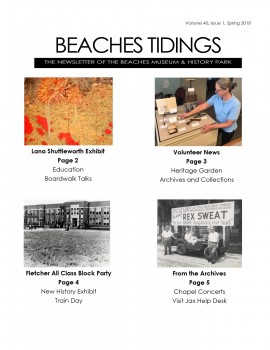 The Spring 2018 issue of Beaches Tidings, The Newsletter of the Beaches Museum & History Park, is now available. Click here to read this edition of Beach Tidings.
The Spring 2018 issue of Beaches Tidings, The Newsletter of the Beaches Museum & History Park, is now available. Click here to read this edition of Beach Tidings.
This article was written by Master Gardener Lee McDonald in honor of the 10th Anniversary of the Beaches Museum Heritage Garden.
April 1, 2018 marks the 10th Anniversary of the Heritage Garden in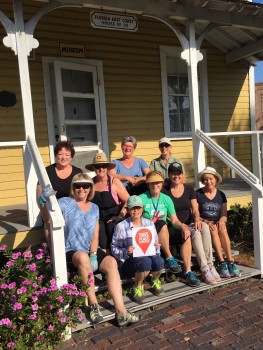 Jacksonville Beach. Located on Beach Blvd at the Beaches Museum & History Park, the garden, a Duval County Extension Demonstration Garden, is maintained by Master Gardener volunteers with the purpose of community education in gardening practices.
On its first anniversary, Jacksonville’s mayor designated the garden as one of the city’s top greenspace revitalization projects. Soil is critical to successful plantings because, as in much of Florida, our soils are very sandy. In by-gone days, soils here were naturally composted by horses, cows, chickens, and more roaming fauna than we see today. Fallen leaves were returned to landscapes and ash from heating and cooking were turned into the sand and soil. These historical practices made soils more suitable for gardening due to rich natural and scheduled amendments.
Composting remains essential to sustainable gardening. Thus, it is not surprising that the first order of business on April Fool’s day in 2008 was to collect composted horse manure from a local farm and plow it into the soil. These soil restoration practices from that initial day have made continued maintenance and development productive at the Heritage Garden.
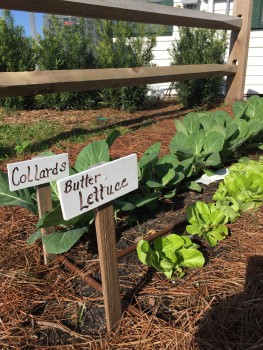 Mid-20th century, folks discovered that much chemical fertilization could boost turf and gardens around homes. The last seventy years, however, have taught us that practices, including excessive applications and misuse of certain chemicals in herbicides, fertilizers, and pesticides, damage the water table, successful human habitation, and the environment, creating a less sustainable community. As a learning center, the garden’s goal is sharing best garden practices. Volunteers show Extension recommended practices, observing how plant choices and gardening methods work to support quality of life in our specific environment.
The 2008 Heritage Garden, envisioned to complement the turn-of-the-twentieth-century Foreman’s House, was confined to a space measuring thirty percent less than the 13′ x 18′ space is occupied within two years. Numbering fewer than ten in 2008, MG volunteers now number thirty. Over the past four years, the garden has expanded rapidly; specialized garden areas include the kitchen (vegetable and herb), rose, perennial, butterfly, shade or ginger, and bromeliad gardens as well as specialized plantings of historical native and non-native plants throughout the park. At present, the garden hosts over 240 varieties of plants with new additions every season. It is accessible with paved pathways and ramps meeting ADA standards. Visitors may wander through and observe the garden during museum hours. Tours are available by reservation. School and civic groups regularly schedule visits to tour the garden and museum exhibits.
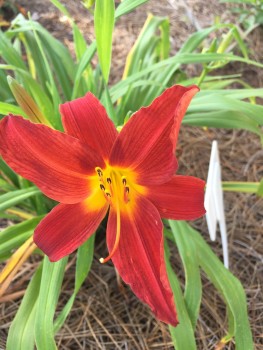 In 2012, the Heritage Garden was recognized by UF/IFAS Florida Master Gardener Program as one of Florida’s most outstanding demonstration gardens. Over the decade, we have faced typical challenges of Florida living, actively engaging in renewal and sustainable practices for both edible and ornamental plant growth. The garden has weathered development and redevelopment with the addition of two newly moved and restored historic buildings which altered the footprint of the garden as well as storms and hurricanes which served as reminders of the history of our community. The French first recorded a hurricane here in 1564; but human habitation here at the mouth of the St. John’s spans thousands of years. The Beaches Museum and Heritage Gardens presents the simple, amazing history of the region we call home. The Heritage Garden is a demonstration of practices which will yield a successful home garden on our island today.
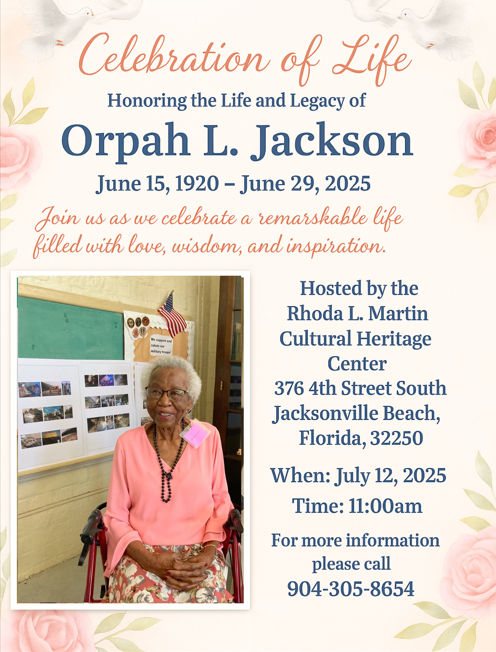
This article was written for the February and March 2018 Spotlight Exhibit on Orpah Jackson (1920 – 2025) created by Spring 2018 Beaches Museum interns, Dylan Franke and Nick Iorio.
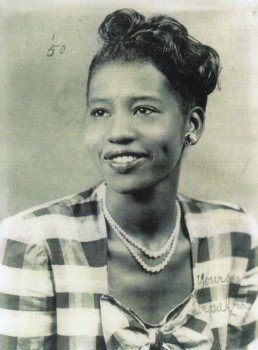 Orpah Jackson was, and continues to be, an important member of the Beaches community; working as a teacher for 55 years and actively participating in community projects. Born on June 15th, 1920 in Lumpkin, Georgia, her family later moved to a small neighborhood in East Mayport, Florida when she was 6 years old. This move was influenced by her mother’s desire to provide a better education for Orpah and her brother.
Attending school as an African American was difficult. After sixth grade, Orpah had to find methods of travelling into Jacksonville to attend Junior High School. In 1940, Orpah graduated from Stanton High School and five years later from Cornell University. She then moved to Melbourne, Florida where she began her first teaching job.
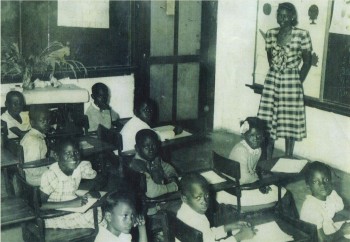 In 1946 she moved back to Duval County and began a job as teacher and principal of 19 African American students in Mayport Village. When that school was closed in 1948, she began teaching 2nd grade at School #144 in Jacksonville Beach. Here, Orpah taught a wide range of subjects to her 2nd graders including reading, math, music, and physical education for 20 years.
Upon integration, Orpah transferred to Seabreeze Elementary, where she taught for 10 years. Including her years working as a substitute teacher at Neptune Beach Elementary and Atlantic Beach Elementary, Orpah taught until 2000.
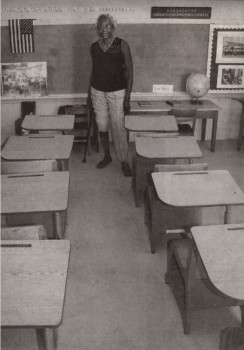 Orpah was involved with many projects including the coordination of the integrated Vacation Bible School for the local churches, working with Meals on Wheels as a member of Church Women United, providing assistance to the neighborhood through the Donner Community Development Corporation, and serving as the first African American woman in Atlantic Beach to work on the voting Precinct. She currently serves as a member and Treasurer on the Board of the Rhoda L. Martin Cultural Heritage Center, which works to preserve the history of School #144 where her old classroom is on display.
Orpah Jackson passed on June 29, 2025. She is greatly missed.
The Holidays 2017 issue of Beaches Tidings, The Newsletter of the Beaches Museum & History Park, is now available. Click here to read this edition of Beach Tidings.
The Fall 2017 issue of Beaches Tidings, The Newsletter of the Beaches Museum & History Park, is now available. Click here to read this edition of Beach Tidings.
Shrimping and Fishing in Mayport
This article is an excerpt from the 2016 exhibit, Mayport Village: On the River of Change.
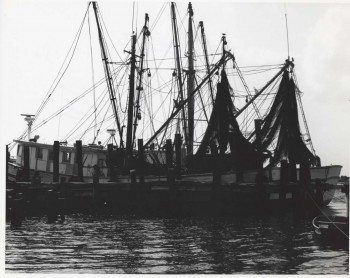
Commercial fishing and shrimping operations have played an integral role in shaping life in Mayport Village for over one hundred and fifty years. Home to some of the oldest shad fisheries in Florida, the industry has experienced several transformations as technology and infrastructure has evolved.
In the 1850s, New England fishermen discovered the mouth of the St. Johns River was teeming with shad, mullet, alewives, and other marine species that relied on fresh water for feeding and spawning. By the 1870s, several Connecticut-based boat captains, including Captain David Kemps, Sr. relocated to the Mayport Village area to make a living. Deploying shad-nets, mullet-nets, haul-seines and gill-nets, they fished alongside expert African-American fishermen who were chiefly responsible for the fisheries’ daily operations. More than three-fourths of the catch was sold to dealers in Savannah.
By the early 1900s, mullet and shad populations dropped dramatically. Mayport captains attributed this to the unrestricted use of gill-nets and the increasing presence of steamboats in the river.
New opportunities arose in shrimping, however, by the 1920s. The advent of motorized fishing vessels made offshore shrimping a feasible and lucrative venture. The arrival of experienced Portuguese fishing families, the Rowlands and the Perrys, that same decade breathed life into a nascent industry.
By the 1950s, shrimp docks dominated the horizon of Mayport. Local men like Johnny Vona, Booty Singleton, Mathias “Matt ” Roland, Mr. Parnell, Manuel Jesus, Jesse Perry, and A.J. Ruffin were the backbone of the industry. Two decades later, more than 150 shrimping vessels were unloading their catch at Mayport Village docks. Nearly everyone in the village had a shrimper in their family. A popular local pastime was to greet the boats as they entered the village to see the day’s catch.
The late 1990s and early 2000s, however were unkind to the once-bustling shrimping fleet. Local shrimpers credit rising gas-prices and foreign imports of Ecuadorian and Asian shrimp for the industry’s decline. Today, Safe Harbor Seafood is the last remaining dock open for commercial offload.
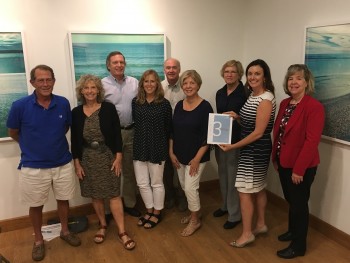 The Beaches Museum & History Park’s Board of Directors started its 2017-2018 year strong with the presentation of its new Strategic Plan. The 10-month process was supported by the Community Foundation and was facilitated by Jana Ertrachter, the Ertrachter Group, who brought years of experience guiding organizations through the Strategic Planning Process.
A 12-member team comprised of board members, staff, volunteers and community members met monthly to gather and share information, derive key strategic issues and to assemble the roadmap for the Museum’s next three years.
Among other things, the group proposed new mission, vision and values statements that were unanimously adopted by the board at their October 10 meeting. The new mission statement of the Museum is “To preserve and share the distinct history and culture of the Beaches area”.
In addition to presenting the Strategic Plan, the new officers and two new members were announced. 2017-2018 officers will be: President-Jack Schmidt, Vice President-Linda Lanier, Treasurer-Randy Hayes and Secretary-Bill Carter. The board welcomed Chris Pilinko and Claudia Estes.
“We have a busy year of interesting programming, engaging special events and even more initiatives to share the fascinating history of our community” says Jack Schmidt, Board President. “Having the right board, volunteers and staff in place are key to making all of our endeavors a success and we look forward to a great year”.
Please visit Our Mission page to learn more about the Beaches Museum’s Vision, Values, and to review a complete copy of the Strategic Plan.
Admission to the Beaches Museum is free and information about programs and events can be found by calling 904-241-5657.
Charlie Holbert was having dinner with his wife and two young sons on Wednesday, Sept. 27, 1967, when he first heard the roar of an approaching airplane flying dangerously low over his home in the Ocean Forest section of Jacksonville Beach.
The Southern Bell traffic engineer ran outside just in time to catch a fleeting glimpse of a U.S. Navy plane struggling to stay aloft in the rapidly disappearing daylight. Holbert’s three-bedroom house was within easy walking distance of the Intracoastal Waterway where the crippled plane seemed to be heading. Seconds later, he heard “the sickening sound” of the plane crashing into the nearby mud flats.
Forty-five years later, after reading a retelling of the crash in The Beaches Leader, Holbert came to the realization that he and his family may actually owe their lives to the heroic actions of the pilot of that ill-fated maritime patrol plane, Lt. Michael P. Myers.
Seconds earlier, the aircraft had collided with a Navy jet that had lost radio contact with its Mayport-based aircraft carrier, the USS Shangri-La. The mid-air collision, which occurred around 6:30 p.m., took the lives of six servicemen: five in the patrol plane and one in the F-8 Crusader jet. Many believe the 30-year-old Myers deliberately ditched his aircraft into the river to avoid any collateral damage on the ground.
After clipping the tail section of Myers’ plane, which was headed south to NAS Jacksonville, the Navy jet plunged into the Intracoastal, its lone occupant, Lt. (j.g.) Mark E. Garrett of Light Photographic Squadron 82 of NAS Cecil Field, still strapped into the cockpit. An airman permanently assigned to Myers’ plane gave up his seat on the twin-engine turboprop so 19-year-old Philip R. Huggins could get some flight time. Also killed were radioman Marion E. Young, 25, and Lt. Cmdr. R.H. Ford, 33, a Naval Reserve co-pilot on a two-week active-duty assignment. “It was a sad experience to see so many friends lost that day,” recalled the airman whose life was spared.
Holbert wasn’t the only eyewitness to history. Nancy Broner was at Fletcher High’s football stadium cheering for her junior high classmates when she noticed something alarming in the sky overhead. “Those planes are going to collide,” Broner recalled in 2012. “One of them went nose down.”
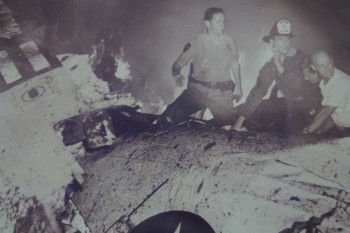 Rush Abry, a well-known Beaches photographer, managed to capture the only image of the crash site after wading through chest-high water to reach a tiny island where the patrol plane crashed and burned upon impact. His stunning black-and-white photo of four first-responders straddling the plane’s crumpled fuselage as a fire blazes behind them won a state press award for on-the-spot photography.
Abry’s waterfront home in Jacksonville Beach overlooks the marsh and the scene of the crash. A few years ago, the widow of Charles M. McLarty, a 26-year-old crewman on the aircraft, traveled to Jacksonville Beach to pay homage to her late husband. She and Abry posed for a picture on the back patio of Abry’s home with the island hauntingly looming in the background. Shortly after the tragic accident, Sheila McLarty (now Moore) and Lt. Myers’ widow, Jeanne Hand, invited Lt. Garrett’s widow, Linda, to dinner. Each had suffered a tremendous loss, but their friendship didn’t suffer because of it. Recalled Hand 45 years later: “I wanted Linda to know that we were not upset with her, and that there were no hard feelings.”
This article is an excerpt from the 2017 exhibit, Atlantic Beach: From the Continental to a Coastal Community.
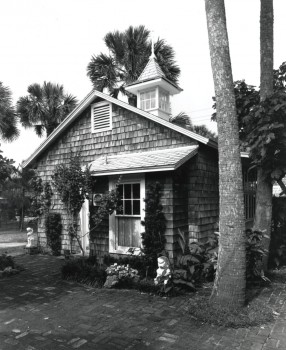 The unique and memorable buildings of Atlantic Beach have greatly contributed to the character of this community throughout its life. The Continental Hotel – a monumental structure built at a time when there were almost no other buildings around – set the tone for the future of the community. The people who shaped Atlantic Beach in its early days hoped to form a more upscale community that drew in more elite residents. From converted carriage houses to a “hobbit house,” this trend has led to some of the most unique structures in the Beaches communities. The buildings mentioned below are just a few examples of the architecture found in Atlantic Beach throughout the years.
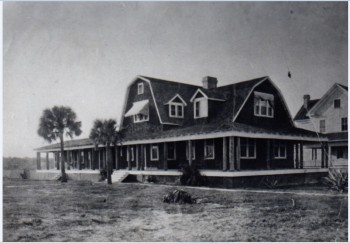 The Bull House. Built around 1902, this house represented some of the earliest construction in Atlantic Beach. The home of several members of the Bull family over the years, it was a longtime landmark in Atlantic Beach.
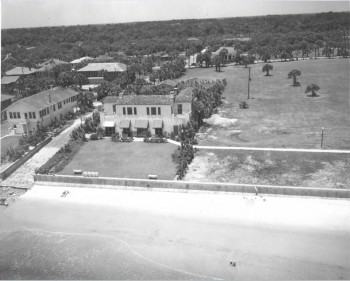
Echidna. Named after the spiny mammals of the same name from Australia, the house was built in 1937 by Hayden W. Crosby of Jacksonville. It would later become the elegant Le Chateau restaurant in the 1950s.
L’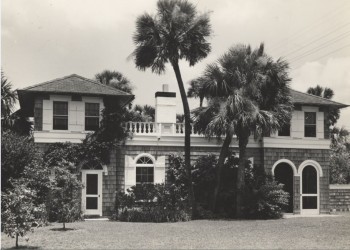 Abri. This Italian Renaissance Revival style house built around 1934 was originally owned by Broadway legend Lawrence Haynes. In his autobiography, “Joyous Life of a Singer”, Haynes attributes the name to a phrase used in World War I: “Vite a L’Abri,” which meant “Quick to the place where we are safe – where no harm can reach us.”
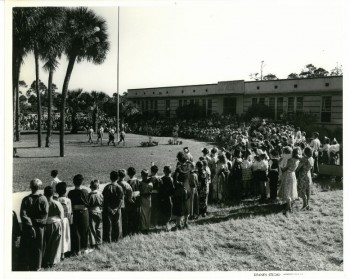
Atlantic Beach Elementary School. Built in 1939, the Atlantic Beach Elementary School has been a significant part of the community for many years. The most notable aspect of this building is its pink exterior with blue trim.
Captions for Images used in the article
1) “P-2509” – No caption
2) “840” – The Bull House
3) “3825” – Echidna
4) “1152” – L’Abri
5) “AB Students Celebrating May Day 5.9.1949” – Students Celebrating May Day at Atlantic Beach Elementary School, May 9, 1949.
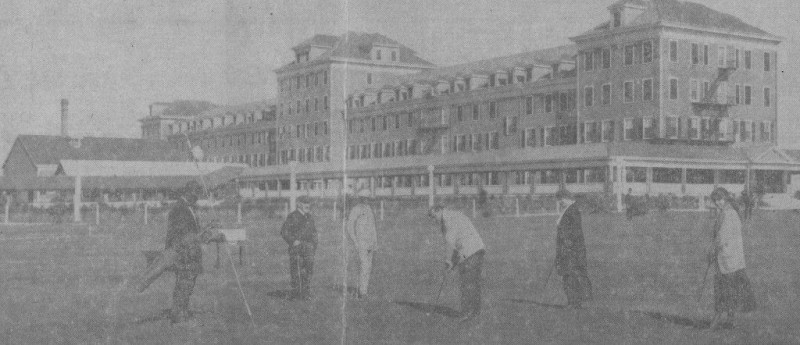 When discussing golf in the Beaches area, most will look towards Ponte Vedra Beach, particularly TPC Sawgrass and the annual PLAYERS Championship. However, Atlantic Beach has its own storied history in the world of golf.
The Continental Hotel introduced the first golf courses to Atlantic Beach. While there was a large 18-hole course for guests to enjoy, a more unique course lay within the grounds, mere feet away from the train station and hotel itself. Famed golf course designer A. W. Tillinghast created a smaller 9-hole course called a Lilliputian Golf Course, which was a reference to the novel Gulliver’s Travels by Jonathan Swift. These courses were also connected to an early Atlantic Beach Country Club.
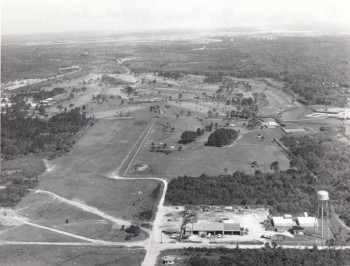 The Selva Marina Country Club, a project initiated by Harcourt Bull, Jr., opened in 1958. Well received in the area, it featured a golf course designed by E. E. Smith and quickly grew to include tennis courts, a swimming pool, and a residential community. Selva Marina soon became an important and internationally recognized part of the community. It is best remembered as the birthplace of the Greater Jacksonville Open in 1965. Years later, this tournament became what is now known as the PLAYERS Championship. Playing host to many of golf’s greatest players including Arnold Palmer and Jack Nicklaus, Selva Marina created a name for itself in golf history. The Lady Jacksonville Open was also held at Selva Marina in 1975.
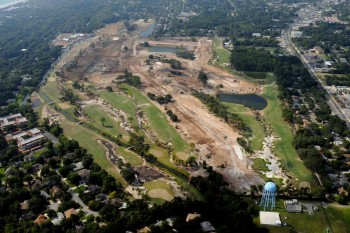 Today, the new Atlantic Beach Country Club continues Atlantic Beach’s golfing legacy at the site of old Selva Marina Country Club. In addition to the 6,815 square foot course redesigned by Erik Larsen, Atlantic Beach Country Club currently includes a neighborhood with 178 homesites, tennis courts, fitness facility, a junior Olympic swimming pool, and a 16,000 square foot clubhouse. Opened in January 2015, the revitalized 18-hole course was named as one of the nation’s Best New Courses by Golf Digest Magazine in 2014. The Web.com Tour Championship, part of the PGA TOUR, will be held at ABCC in Fall 2017.
Captions for Images used in the article