Brittany Cohill Named Associate Director of the Beaches Museum
|
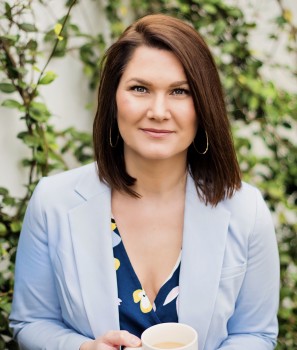 The Beaches Museum announced that Brittany Cohill has been promoted to Associate Director, effective immediately. In her new role, Cohill will oversee general educational programming, exhibits, archive and collections management, and the college/university internship program. Cohill will continue to report to Beaches Museum Executive Director Christine Hoffman.
|

|
|
This article was written and contributed by Karen Thomas
 In 1984, the Beaches Area Historical Society hosted a series of events recognizing the centennial of Jacksonville Beach. Founded in 1884 by the Scull family, Jacksonville Beach was first known as Ruby Beach. William E. and Eleanor Scull were the first family to settle the area, working a post office and general store while living in tents on the beach with their two children, Ruby and Bessie. What began as a small, nearly unpopulated, nineteenth-century outpost on the route between Mayport and St. Augustine eventually grew into the thriving and lively Jacksonville Beach that Jean McCormick and the Beaches Area Historical Society wanted to commemorate with a centennial celebration in 1984.
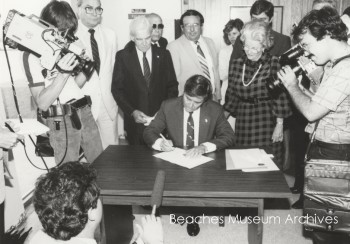 The celebration kicked off in 1983 when Florida Governor Bob Graham signed a proclamation designating 1984 as “Jacksonville Beaches Area Centennial Year.” From there, the Historical Society – led by Jean McCormick – spearheaded plans to ensure that the centennial celebration of Jacksonville Beach would be a year full of activity and events.
In April of 1984, the Society hosted a “Saturday in the Park” event to commemorate several significant milestones in Beaches area history. 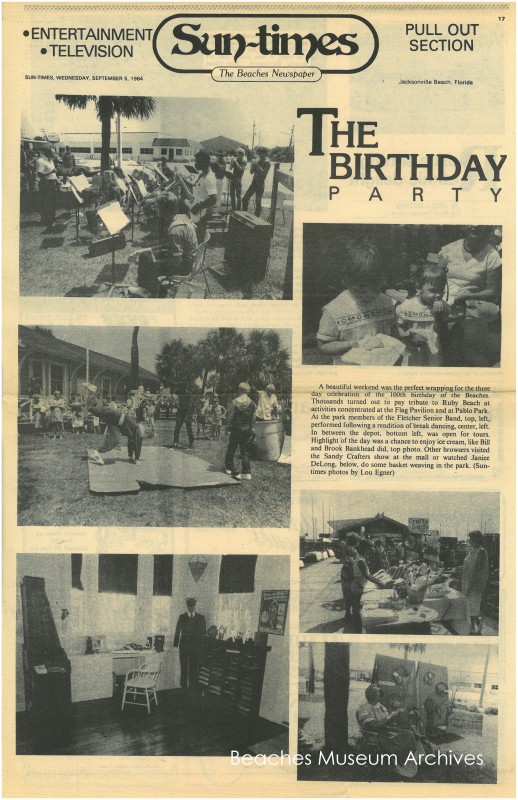
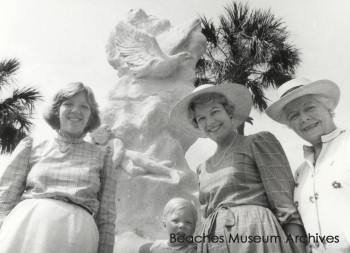
First, there was the unveiling and dedication of the 1932 Lindbergh Baby Monument at its new permanent home in Pablo Park. This was followed by a ribbon cutting ceremony of the newly renovated and restored Mayport Depot. “Saturday in the Park” proved to be a huge hit, even drawing attendance from the grandchildren of the Scull family.
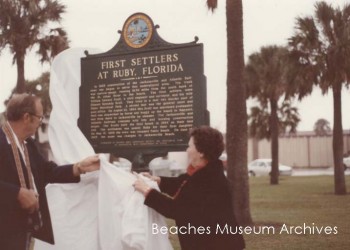
Jacksonville Beach’s centennial celebrations concluded in December of 1984 when the Beaches Area Historical Society placed a historic marker in Pablo Historical Park to commemorate the establishment of Ruby Beach. The grandchildren of William E. and Eleanor Scull initiated this idea and worked closely with the Historical Society in order to preserve this important piece of Beaches history.
The Beaches Mu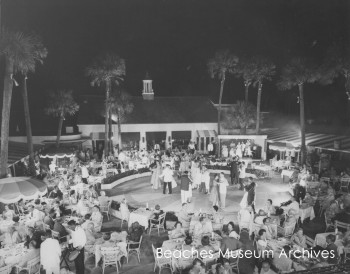 seum needs your memories! Where did you go to hear the latest music with your friends on a Friday night back in the day? Music has long been an important part of life and a way to fall in love with the Beaches area. The Museum hopes to preserve local music history and culture through your stories. You can tell your stories by recording oral history interviews, lending concert programs, posters, t-shirt. Whether you attended the first Jazz Festival in Mayport or were a part of the weekend scene at pier dances or Einstein-A-Go-Go concerts, your memories and experiences are priceless. The Museum will showcase your memories at our upcoming exhibit opening in March 2019. Please contact Sarah Jackson , the Archives & Collections Manager at sarah@beachesmuseum.org to schedule donations.
The Holidays 2018 newsletter is now available!
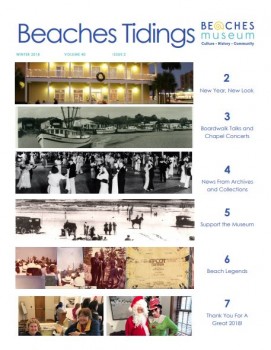
Holiday 2018 cover
This article was written and contributed by Johnny Woodhouse.
In the fall of 1913, New York native Elizabeth P. Stark, the daughter of a wealthy Washington, D.C., attorney, pulled up stakes and moved to North Florida with her German maid, seven horses and three English sheepdogs.
A world traveler educated in Europe, Stark first laid eyes on Mayport while traveling by steamboat between Jacksonville and Savannah.
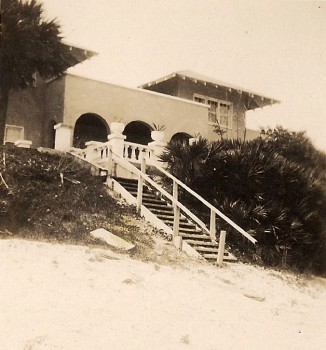
Wonderwood by the Sea, her 375-acre estat in East Mayport, eventually grew to more than 20 buildings, including the Ribault Inn, a lodge and dining facility. Her two-story, white stucco manor that overlooked Ribault Bay was known as “Miramar,” which means sea view in Spanish.
Wonderwood By the Sea featured a 1,000-foot fishing pier, riding stables, a swimming pool, ball fields and an artificial lake. It was once the setting for a 1916 silent film. That same year, Stark was credited with organizing the first Girl Scout Troop in the Jacksonville area, Cherokee Rose Troop 1, made up mostly of girls from Mayport. During World War I, the Girl Scout troop played an active role in civil defense by patrolling local beaches on horseback.
In the ensuing years, Stark hosted numerous dignitaries at Wonderwood by the Sea, including Franklin D. Roosevelt, U.S. Senator Duncan Fletcher, Baron and Baroness DeWitt of Denmark, Colonel William Gaspard of France, and Jacksonville Mayor John Alsop.
Many of these prominent guests came to Wonderwood By the Sea as a result of her brother, Herman Hoffman Philip, an American diplomat and a former Rough Rider with Teddy Roosevelt.
But in 1940, life at Wonderwood by the Sea – and for Mayport as a whole – changed forever when the U.S. government waged an eminent domain battle for Stark’s land.
In 1926, Stark’s properties were worth an estimated $2 million. In 1940, the U.S. government offered her less than $40,000.
When Stark refused to leave, U.S. Marines forcibly occupied the Ribault Inn and later carried her out of her home tied to a chair. With her government settlement, Stark purchased 30 acres of undeveloped property south of the base, off what is now Pioneer Drive. She dubbed her new home Wonderwood Estates.
Stark spent her remaining years there until her death in 1967 at age 91. Once the belle of many official balls, she died alone and penniless and was buried in an unmarked grave in the Pablo Cemetery. Her husband, Jacob, a former prizefighter, preceded her in 1956.
In 1975, the Beaches Neighborhood of Girl Scouts, spearheaded by Brownie Troop 446, raised funds to mark her final resting place with a pink granite headstone etched with the Girl Scouts emblem. In 2010, the Mayport Civic Association recognized Stark’s memorable contributions to the historic fishing village with an additional marker at the foot of her modest grave.
 apping up its 40th year by rolling out a new name and logo. Started in 1978 as the Beaches Area Historical Society, the organization has been a staple in the community with the mission “to preserve and share the distinct history and culture of the Beaches area”.
In celebration of 40 years, the Beaches Area Historical Society produced a video chronicling their accomplishments. Please enjoy!
This article was written by Fall 2018 Beaches Museum intern, Alex Morales.
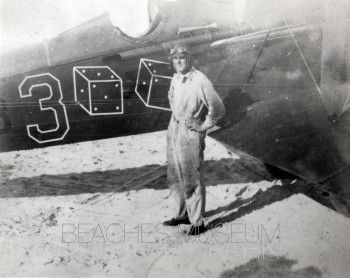 After planes were used during the Great War for air-to-air combat, surveillance, and mail carriers, many U.S. pilots began using their skills to push the limits of aviation technology. Some modified their aircrafts to perform in stunt shows. Others, like Charles Lindberg seized the opportunity to create distance and time records. However, he was neither the only pilot nor the first to make a mark in the aeronautical history books. Jacksonville Beach played host to one famous record breaking pilot, Lt. James H. Doolittle, who set a new transcontinental flight record in 1922.
Before breaking flight records, Doolittle was a flying instructor with the Army Air Service in Eagle Pass, Texas where he performed border patrol duties. After years of planning, Doolittle prepared his military issued DeHaviland plane to withstand the long distance flight across the U.S. He stripped it of excess weight so it could support a 285 gallon fuel tank and still remain light. On August 6, 1922, at Pablo Beach (present-day Jacksonville Beach), a large crowd of well-wishers and spectators gathered to see him take off. As his plane taxied across the beach, it got caught in soft sand making it veer into the ocean.
Although embarrassed by the faux pas, Doolittle made the necessary repairs to his plane to try again. On September 4, 1922 at 10 pm, with just kerosene lanterns to illuminate the beach, Doolittle soared into the skies and into history. Twenty-one hours and nineteen minutes later, he touched down in San Diego and broke the transcontinental flight record. Making only one stop in San Antonio, he averaged a speed of 105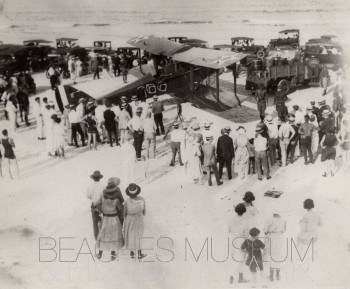 miles per hour and stayed at an altitude of 3,500 feet.
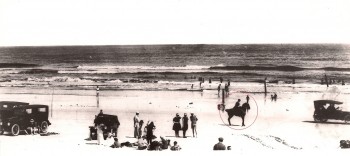
Pablo Beach figured greatly in aviation history due to its location. The distance between San Diego and Pablo Beach is the shortest transcontinental route—a distance of 2,270 miles. The southern route contained fewer mountain ranges and provided relatively better weather conditions for flying. With more military bases along the route, it also ensured that pilots had more opportunities to land safely, refuel, or to seek assistance and shelter in emergency situations. Additionally, beaches served as a prime location for airplanes as the long stretches of sandy shoreline provided an area for pilots to land and take off.
Before Doolittle, Robert Flowler’s flight on October 20, 1911 was the first southerly coast-to-coast flight to land in Pablo Beach. His endeavor took 115 days. Albert D. Smith and his group took 18 days to land in Pablo Beach in 1918. The following year, Major J. T. McCauley flew from coast to coast in 25 hours and 45 mins. Two years later in 1921, Lt. William DeVoe Coney landed in Pablo Beach from San Diego i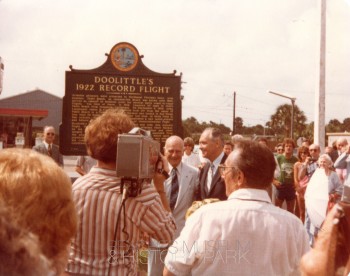 n 22 hours and 27 minutes.
After making aviation history, Doolittle went on to become a Lieutenant General in the United States Air Force. On April 18, 1942, he and his crew, the Doolittle Raiders, flew 16 bombers leading the first surprise raid on Tokyo. His actions during WWII earned Doolittle military distinctions.
Years later, the Beaches Area Historical Society sought to commemorate the military hero for his role in the history of Jacksonville Beach. On September 4, 1980, the Society invited Lt. Gen. Doolittle back to Jacksonville Beach to unveil and dedicate a marker honoring his historic flight in 1922. The marker continues to stand tall in the Museum’s history park.
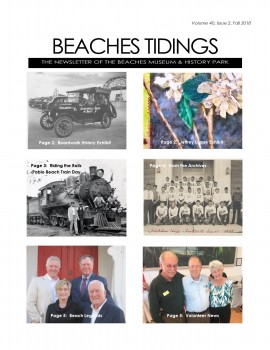 The Fall 2018 issue of Beaches Tidings, The Newsletter of the Beaches Museum & History Park, is now available. Click here to read this edition of Beach Tidings.
By: Alex Morales, Summer Intern
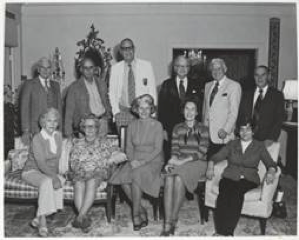
In the late 1970s, the City of Jacksonville Beach moved forward with plans to further urbanize the area. With urbanization efforts in full swing, Jacksonville Beach resident, Mrs. Jean McCormick, became concerned for the lack of historical preservation efforts and available information regarding her hometown’s past. On February 22, 1978, Mrs. McCormick and her Husband, J. T. McCormick invited a group of friends over to their house for cherry pie to celebrate President George Washington’s birthday.
She discussed the need to increase community awareness, preservation efforts to protect significant structures and landmarks and, most of all, to celebrate the rich history of the Beaches. With that, the friends formed the Beaches Area Historical Society. Their mission became “to plan a future for our past.” With that mission in mind the group set out to create a comprehensive history by designating Mayport, Atlantic Beach, Neptune Beach, Jacksonville Beach, Ponte Vedra Beach, and Palm Valley, Florida as the Beaches Area.
Gathering local support and funding became a forefront issue. The Society spread their mission through 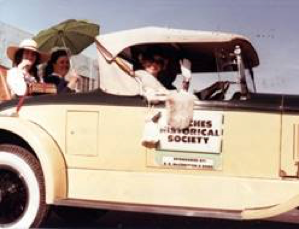 word of mouth, letters amongst friends, running newspaper articles, as well as networking with other historical preservation groups and city council members. Likewise, the Society became heavily involved in local community activities. The April Opening of the Beaches parade signaled an early turning point for the Society. With a massive community turnout, an unexpected explosion of a nearby buggy during the parade ignited community awareness of the Society. Mr. Charles Cook Howell, Jr. wrote in a small note to Mrs. McCormick stating, “a true Champion has started the society off with a bang! This certainly argues well for the future.”
In the following months, the Society saw a jump in membership and elected their first Officers and Board Members. In July, they created an official logo and drafted their first newsletter to mail members in the community. By October, the Society organized their first historical exhibits. Not having a facility or museum did 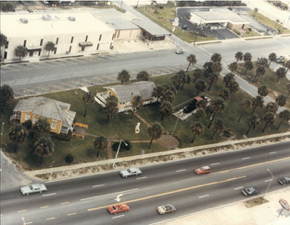 not stop them from putting one together. They utilized two small spaces in the Ocean State Bank and Beaches Guaranty Bank to display two exhibits “full of Memorabilia” that even included a 100,000 year old mammoth tooth.
It was not until March 1, 1979 that the Society became a registered nonprofit organization. With an official title in hand, they arranged quarterly talks for members and invited the extended Beaches community to listen to lectures on local history. In May, Jacksonville Beach City Council approved the Society’s petition for a flat-ironed shaped property located between Beach Blvd and Pablo Ave to establish a historical park. They 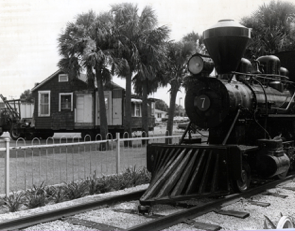 appropriately named it Pablo Historical Park after Jacksonville Beach’s previous name. The park eventually became home to five “at risk” structures, items, memorials, and markers representing and celebrating the bygone era of the Beaches Area. However, the addition of the Beaches Museum and History Center in 2006 ushered a new phase of the Society’s role in the community.
After forty years, the Beaches Area Historical Society continues to be a staple of the Beaches Area community. Despite the passing of time and a changing landscape, the spirit of the Society continues to endure with its new mission: “to preserve and share the distinct history and culture of the Beaches area.”