Beaches Museum Closed Thursday, July 4th
The Beaches Museum will be closed for the holiday on Thursday, July 4th. We will resume normal operating hours Friday, July 5, 10:00 a.m. – 4:00 p.m.

The Beaches Museum will be closed for the holiday on Thursday, July 4th. We will resume normal operating hours Friday, July 5, 10:00 a.m. – 4:00 p.m.
By Johnny Woodhouse
Faye Mickler Farace was curling her eyelashes in the girl’s bathroom at Fletcher High when one of her classmates burst in and said, “Oh, you have see this new guy, but I’m going to get him first.”
The “new guy” was Charles Harby “Buddy” Page Jr., a handsome transfer student from Landon High who had just moved to the Beaches in the fall of 1951.
“He was very good looking. I mean he was perfect,” recalled Farace, now 89. “All the girls were crazy about him. He dated a girlfriend of mine before he eventually asked me out at the end of our junior year. From then on, we started making our plans.”
A gifted athlete, Page quickly caught the eye of Fletcher High athletic coaches, including football coach Ish Brant, who was coming off a 7-2-2 season in 1950.
Brant was always on the lookout for fleet-footed halfbacks to buoy his T-formation offense and the 6-foot-tall, 165-pound Page fit the bill.
“He worked out with weights long before any of us did,” recalled Lee Buck, who played with Page on Fletcher’s 1951 and 1952 football squads. “He was very muscular and would literally bounce off tacklers.”
Page broke into Fletcher’s starting football lineup midway through his junior year. The following spring, he helped the Senators win the 1952 Class A state track title as a point-scoring sprinter and relay runner.
Off the playing field, Page bonded with the likes of Tommy Hulihan, Henry “Preacher” Stout, Stacy Barber and Buck, all members of the Class of 1953.
“Tommy’s house on Laura Street [in Neptune Beach] was our meeting place,” said Buck. “His mother treated us like we were her own sons.”
“We were all very close,” added Farace, a former Fletcher majorette and Homecoming Queen. “Tommy and Buddy were the best of friends. It was a wonderful time back then. About the worst thing we did was smoke cigarettes.”
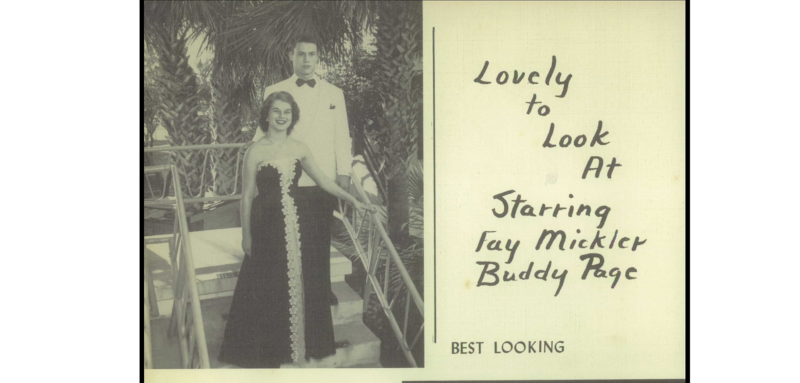
In 1953, Page and Farace were voted “Best Looking” in the yearbook.
“I wonder if that’s Fay Mickler driving up to the theater in that big limousine. She’s quite a celebrity with her titles of Miss America and Mrs. Charles Page Jr., that famous professional football player,” the yearbook’s “class prophecy” section predicted.
Fletcher opened the 1952 football season with a dominating 33-18 victory over Live Oak Suwanee. Page scored the game’s opening touchdown to get the visiting Senators rolling. It would be the first of nearly a dozen TD runs for the speedy senior halfback whose name and image appeared in sports pages on a regular basis.
“Page is fleet of foot and capable of getting away for sizeable gains,” wrote sportswriter Rocco Morabito of the Florida Times-Union before Fletcher’s first home game of a season, a 35-6 triumph over visiting Miami Tech.
A photo and caption proclaiming Page a “breakaway threat” appeared in the T-U sports pages, leading up to Fletcher’s game with Clearwater Central Catholic.
Heading into the season finale against Lake City on Dec. 14, 1952, Brant, Fletcher’s silver-haired head coach, told a T-U sportswriter, “Page offers a terrific backfield threat and if we need one or two yards, he’ll blast in there and get it.”
A week before the Lake City game, which was played at the Gator Bowl, Page and teammate Larry Adams, Fletcher’s top scorer and leading pass catcher, were both offered football scholarships to the University of Florida.
Adams (70 points) caught more than 10 TD passes for the Senators in 1952 and handled all the punting and extra-point kick duties.
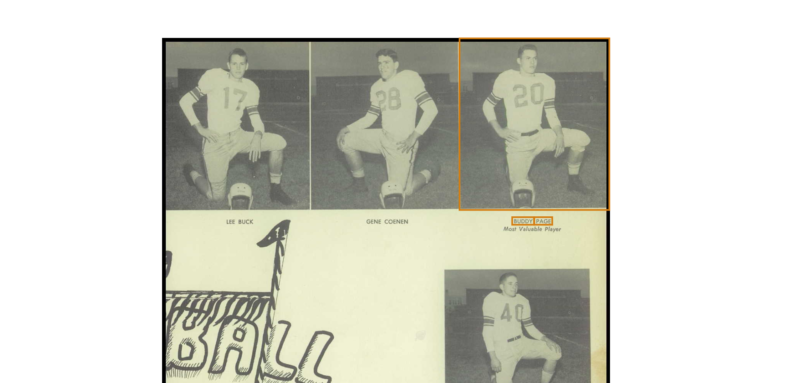
Page (66 points), who averaged 8.5 yards per carry during the regular season, was Fletcher’s most valuable player.
“Coach Ish Brant is high in his praise of both boys, and feels they had a heavy hand in helping his team to a 9-2 season, the best record Fletcher ever has posted,” The Jacksonville Journal reported.
In mid-August 1953, Page and Adams, along with Fletcher’s Bert Bibby and John Veal, participated in the North-South All-Star Game at the Gator Bowl. The fifth annual event featured many of the best football players in the state, including Miami quarterback Lee Corso, who led the South All-Stars to a 33-6 win.
Adams caught an 18-yard pass in the game and Page was photographed carrying the ball while being chased by a pair of would-be tacklers. “The crowd was brought to its feet in the second quarter of last night’s all-star game as the North’s Buddy Page picked up eight years around left end,” a T-U photo caption read.
Page and Adams split up after the all-star game, with Adams heading off to play for the University of Florida and Page signing with in-state rival Florida State University.
When Page arrived in Tallahassee for the first day of drills on Aug. 24, 1953, FSU’s incoming freshmen class was considered “the best crop of newcomers ever lined up for the Seminoles.” In a team photo, Page is pictured sitting next to Fletcher grad Jimmy Messinese, one of FSU’s 34 returning lettermen.
Messinese, a backup linebacker, and Fletcher grad George Boyer, a starting defensive tackle, appeared in numerous games for FSU in 1953, but Page apparently left school before the football season began.
“His parents were pushing him to stay in college, but Buddy made up his mind to go into the Army,” Farace recalled. “His plan was to serve for two years and then play football for the University of Florida. He said we could live in some Quonset huts on campus that were reserved for married couples.”
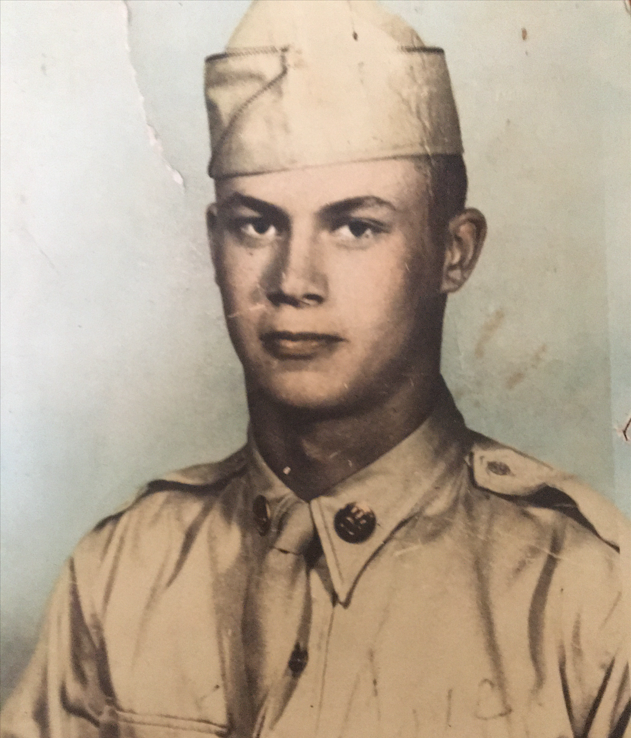
Page enlisted in the Army on Sept. 17, 1953, and completed basic training at Camp Gordon (now Fort Eisenhower) near Augusta, Georgia. From 1948-1975, Camp Gordon was home to the Army’s Military Police School.
After graduating from boot camp, Page was selected to attend 16 weeks of MP training at Camp Gordon’s Provost Marshal General Center. The training included eight weeks of advanced infantry tactics and eight weeks of training in the duties and techniques of being a military policeman.
“MPs are among the best trained, best uniformed and sharpest soldiers in the United States Army, and ready to answer the call from whatever spot on the globe it might come,” proclaimed a black-and-white training film produced at Camp Gordon in 1953.
For Page, answering the call meant reporting to the 8455th Military Police Company at Killeen Base, a remote Army installation in central Texas and one of three sites in the country for the storage and assembly of nuclear weapons during the early years of the Cold War.
“I remember driving up to Camp Gordon with Buddy’s parents, Harby and Roberta Page,” said Farace. “Once Buddy got to Killeen, we never saw him again.”
In 1947, Killeen Base, now known as Fort Cavazos and before that Fort Hood, was one of several ideal spots to store the nation’s nuclear arsenal, according to The Fort Hood Herald. “The idea was (the sites) were built inland to a point where, at the time, the Soviet Union didn’t have the capability to reach in and attack,” said Charles Lauer, formerly director of the Fort Hood Underground Training Facility, which once housed the atomic bomb.
According to Lauer, military personnel stationed at Killeen Base were forbidden to enter parts of the facility under Atomic Energy Commission control. “At the time, when the country’s nuclear arsenal was in its infancy and bombers were the only reliable delivery system, Killeen Base operated on a complex set of protocols,” Lauer said.
Dotted with ammunition bunkers, concrete guard towers and razor-wire fences, Killeen Base, also known by its code name Site Baker, was off limits to visitors and area residents. “Security was extremely tight, producing many stories and rumors about what went on inside,” according to another published report.
One rumor involved a couple of deer hunters who accidentally strayed onto the base. The hunters were reportedly arrested by MPs and held until it was determined that they were not communist spies.
“The only way you can leave here is if you go crazy or shoot someone and then they ship you out,” Page told Farace in a 1954 letter. “I can’t leave this base no matter what. I won’t leave here until I’m out of the Army.”
When Page arrived at Killeen Base in January 1954 at age 18, he quickly learned that leaves were rarely granted, and transfers were out of the question.
“I went to the CO about going into the Airborne, but found out I couldn’t,” he told Farace in another letter. “The most important thing to me is having you with me, so let me know when you want to get married. I will start working things out. Let me know what kind of ring you want or if you want to wait until I come home. Love you forever, Buddy.”
On July 1, 1954, a U.S. Army plane crashed during a training flight at Kelly Air Force Base, in San Antonio, Texas, killing two men, including John McBride, a 20-year-old student pilot and a promising running back who played on Alabama’s 1953 Southeastern Conference championship team.
Page, who turned 19 on Feb. 3, 1954, was also cut down in his prime that July after being fatally shot while on vehicle patrol in a classified area of Killeen Base.
According to a newspaper report, Page, who was riding as a passenger in a patrol vehicle, was shot in the chest by a sentry on July 4, 1954, after allegedly failing to answer the sentry’s challenge.
“The deceased fell from the vehicle and died shortly thereafter approximately 20 feet from the vehicle,” a report said. The MP driving the patrol vehicle was not injured. At the time, military officials said the sentry would be court martialed.
When he was shot, Page was dressed in Army fatigues and carrying only a pocketknife and an MP whistle, according to medical records.
“Buddy reportedly told the guard, ‘You know who I am,’ but the guy still shot him,” said Buck. “His death was such a shock and a senseless waste of life.”
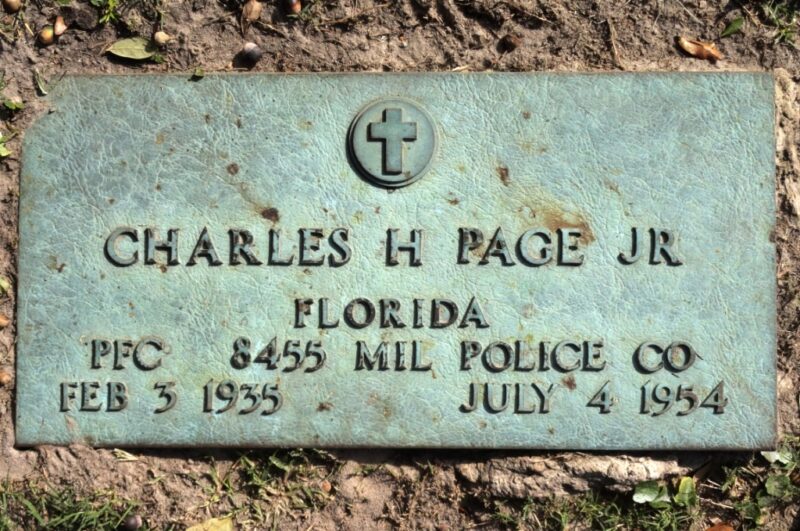
Farace was returning home from a trip to Daytona Beach when the tragic news reached her.
“My mother met me outside our home on Mickler Road and said, ‘Buddy has been killed.’ I don’t remember much after that,” Farace recalled. “Somebody took me to Buddy’s house, and I stayed in a spare bedroom for a couple of days waiting for the train to bring his body back to Jacksonville. To this day, I don’t know how we got through it.”
Two MPs from Page’s unit, Pfc. James L. Morris and Sgt. Clarence E. Van Nest, accompanied the steel casket to the Jacksonville train station and served as official military escorts during the funeral. Buck said he and some of Page’s closest friends took turns standing vigil at the funeral home after Page’s remains were prepared for viewing.
A memorial service was held a few days later with the Rev. Malcolm B. Knight, pastor of Southside Baptist Church, and the Rev. Henry Stout of Community Presbyterian Church in Atlantic Beach, presiding. Page’s remains were buried at Jacksonville’s Oaklawn Cemetery with full military honors.
Four days after Page was killed, U.S. Sen. George A. Smathers of Florida requested a full investigation of the shooting. “Smathers said he acted immediately after receiving the request from Page’s father,” according to a front-page article in the Florida Times-Union. “Sen. Smathers said he has also called the Judge’ Advocate General’s Office and was assured by Major Gen. Albert C. Smith that the investigation would be followed through by that office,” the newspaper said.
On June 28, 1955, U.S. Rep. Charles Bennett of Jacksonville introduced a bill (H.R. 7074) in the U.S. House of Representatives “for the relief of Mr. and Mrs. Charles H. Page” in the sum of $25,000.
The bill was referred to the House’s Judiciary Committee and forwarded to the Office of the Quartermaster General, which was directed to prepare a report for Congress.
In March 1967, Bennett’s bill was finally passed in the U.S. House and sent to the U.S. Senate for consideration. By then, the death benefit had been reduced to $14,430, according to published reports.
It’s unclear whether Page’s parents ever saw any compensation. Roberta Page died in 1969, the same year Killeen Base was officially decommissioned as a nuclear storage bunker. Charles Harby Page Sr., who worked for the U.S. Corps of Engineers, passed away in 1973.
“Buddy’s parents never accepted the Army’s explanation for what happened to their son,” Buck said. “His death destroyed them. He was their whole life.”
Farace, who went on to marry twice and has seven children and 10 grandchildren, keeps a portrait of Page in a dresser drawer.
“Even after Buddy was gone, his parents would continue to visit me and my parents,” Farace said. “My parents adored Buddy. His death was a nightmare for all of us.”
Pamela Blalock recorded 578 hours last year, more than any other volunteer at the Beaches Museum in 2023. We are excited to honor her with our first-ever Volunteer Spotlight! We took a minute to sit down with Pam and ask her some questions about her time with the museum. Read on for the full interview!
Interviewer: You’ve got the most volunteer hours. Congratulations on getting all of those hours!
Pam: Thank you.
What did you spend your time doing before committing so much time to volunteering here at the Beaches Museum?
I was working before I retired.
What did you do for work?
I was the HR Manager for the National Air and Space Museum at the Smithsonian.
Do you have a favorite collections item, and if so, what is it?
Ooh… I think I like the Foreman’s House the best.
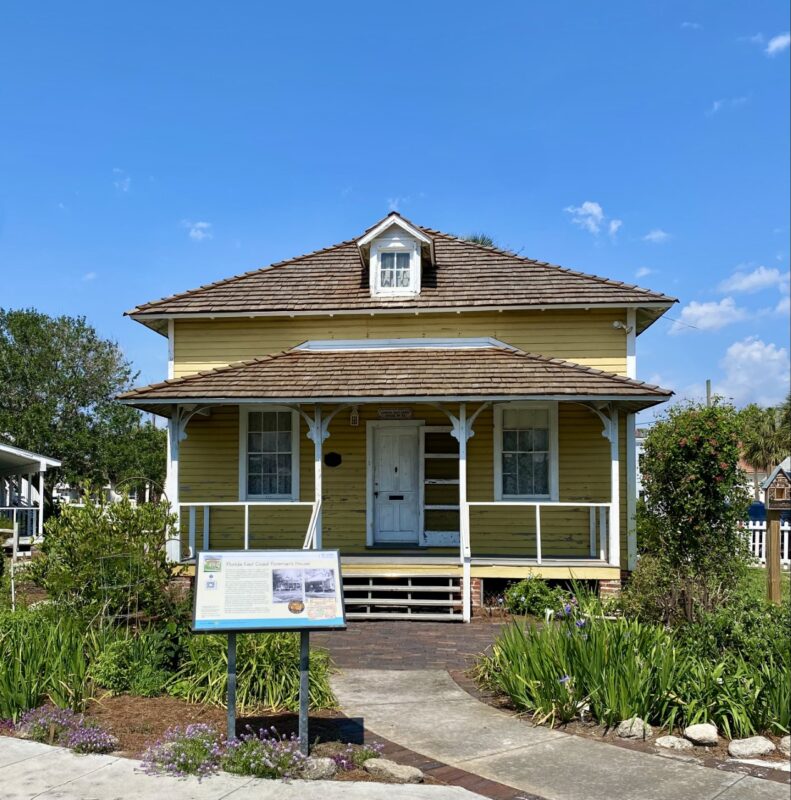
What do you like most about it?
I find the kitchen fascinating, and, um, I don’t know–the adult potty chair. [laughs]
My next question was, do you have a favorite place in the History Park, but I guess–
Oh, well that answers that one, yes.
Do you have a favorite… plant? In the garden?
Oh, I don’t know one plant from another. If it’s not a rose, I don’t know what it is. [laughs]
What has been the most rewarding aspect of volunteering here for you?
Just meeting new people. Getting to make friends and meet people from all over.
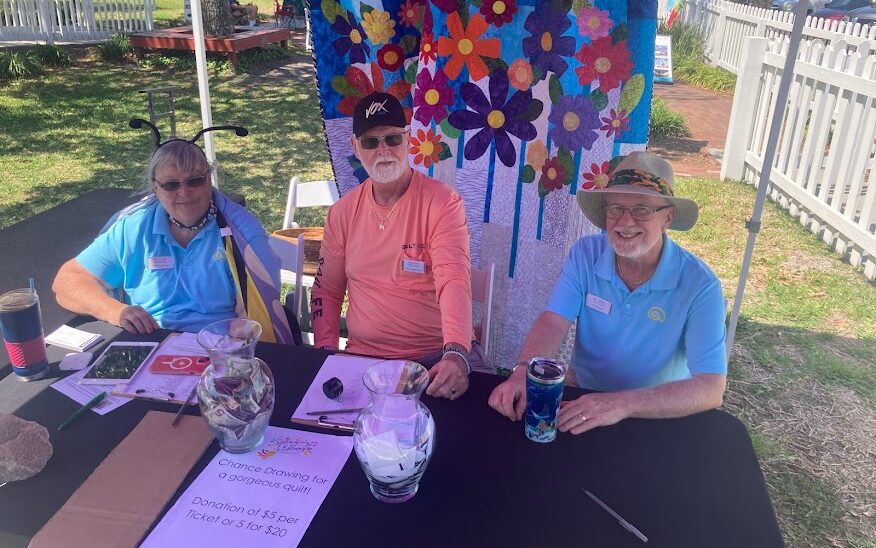
Is there a moment or memory that stands out about your time here?
Other than Kate? [laughs]
Do you have any advice for new volunteers?
Just enjoy your time. I mean, I enjoy it. The reason I keep doing it is because I enjoy it–and it gets me out of the house. It gives me something to do as a way to make friends. That’s why I started here.
You have made lots of friends here!
Well, and I started out at the Smithsonian as a docent doing dinosaur tours! So I was kind of–that gave me something to do. It was just a natural flow once I retired and moved down here.
Did you have a favorite dinosaur at the Smithsonian?
Yeah, the parasaurolophus.
I’ll have to look up how to spell that one.
I just love the name!
If you opened your own museum, what would it be the museum of?
Probably dinosaurs. [laughs]
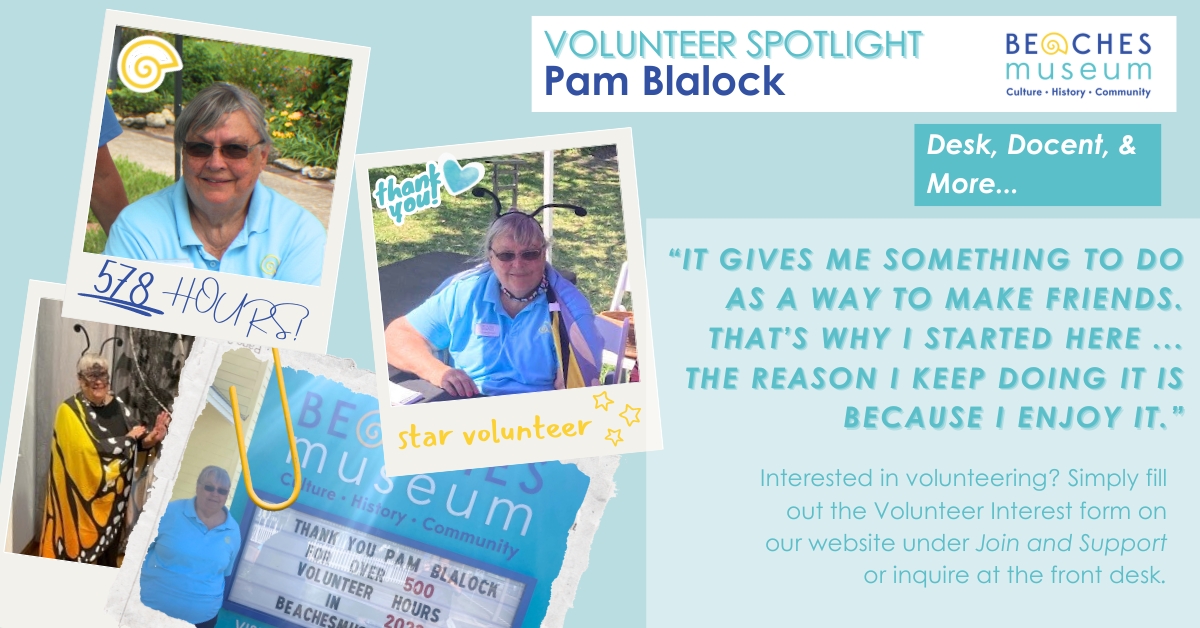
Interested in volunteering? Simply fill out our the form below or ask for an application at the front desk!
The Beaches Museum will be closed on Saturday, January 20 for a private special event. We will resume normal operating hours on Sunday, January 21! We look forward to seeing you!

The Beaches Museum will be closed on Wednesday, August 30 so that our volunteers and staff can stay off the roads during the impacts of Hurricane Idalia. If conditions allow, we plan to re-open for our regular hours, 10-4, on Thursday. Please stay safe and we look forward to seeing you soon!
In celebration of the holiday, Beaches Museum will be close Tuesday, July 4, 2023. We will reopen for our normal hours July 5, 10:00 a.m. – 4:00 p.m.

The Board of Directors of the Beaches Museum recently adopted the proposed 3-year Strategic Plan for the organization. Chaired by Doris McNeill, the Strategic Planning team was composed of board members, volunteers, staff and community leaders and was facilitated by Jana Ertrachter. The group worked for 6 months to compile data, surveys and other relevant information to distill the next three years of the organizations work in to four main goal areas:
Funded in part by The Community Foundation, the comprehensive nature of the strategic planning process will help to guide the future of the Beaches Museum. The Executive Summary of the plan can be viewed HERE.
Researched and prepared by Sarah Sharp, volunteer and occasional writer for the Beaches Museum.
Introduction
For educators interested in Black and African American heritage and history in northeast Florida, especially in Jacksonville, St. Augustine, and the Beaches, numerous people, neighborhoods, cemeteries, buildings, sites, museums, and special collections are available for covering this topic. Topics and sites are richly woven together across heritage and history, place and time, local and national.
1. Overall:
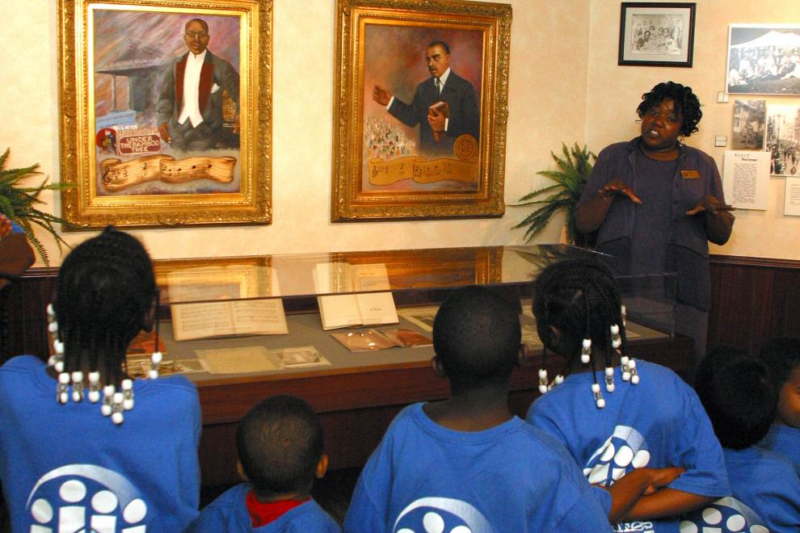
Ritz Theatre and Museum – Visit Jacksonville
Rhoda L Martin Cultural Heritage Center
African American Collection | Jacksonville Public Library
Jacksonville’s yellow fever epidemic of 1888
Unsung Black women are notable in Jacksonville history | Modern Cities
Historic sites awarded restoration funds | Modern Cities
Jacksonville’s surviving Green Book sites | Modern Cities
Jacksonville, Fla. | National Museum of African American History and Culture
Jacksonville’s African-American history showcased at the Ritz
10 Facts About Jacksonville’s Black History
Florida Memory • Florida’s Black History
History of African Americans in Jacksonville – Wikipedia
11 black Jacksonville stories you probably don’t know
Learning about Black History in Jacksonville – Wave Magazine Online
Black Heritage Trail – Visit Jacksonville
Historic African-American Sites in and around Jacksonville, Fla.
The Harlem of the South: Black History in Jacksonville
Jacksonville’s African American Heritage Trail
Historical Jewels in Jacksonville | Modern Cities
4 racial protests and riots from Jacksonville’s past | Modern Cities
Opinion: Erasing Black history does not erase Black people – Jacksonville Today
Opinion: My Thanksgiving wish for a less divided Jacksonville
Opinion: What are we teaching our children? – Jacksonville Today
Opinion: Annoyance, Irritation, & Rage – Jacksonville Today
Uncovering Jax – Visit Jacksonville
Kingsley Plantation – Timucuan Ecological & Historic Preserve (U.S. National Park Service)
The Jax Red Caps: Florida’s first major leaguers
Norman Studios http://normanstudios.org/
Edward Waters College (now Edward Waters University)
Bethel Baptist Institutional Church
Mother Midway Church in East Jacksonville
Stanton Normal School (now Stanton College Prep)
The Cookman Institute (now part of Bethune-Cookman in Daytona Beach) 5 Lost Colleges & Universities of the Inner City | Metro Jacksonville
2. Individuals:
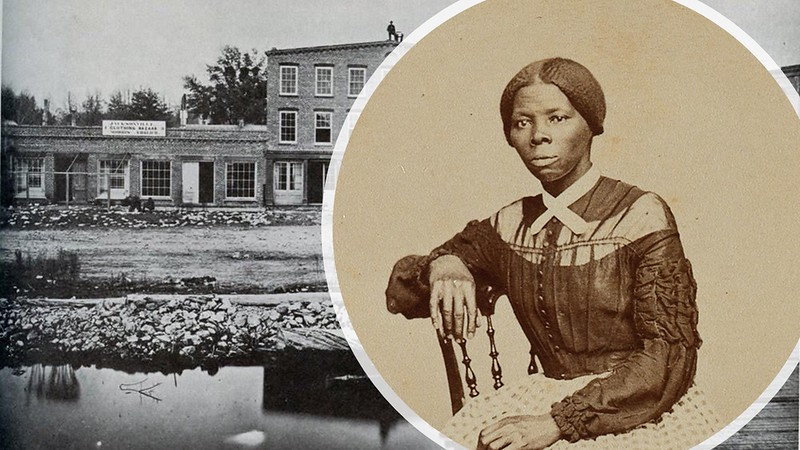
https://www.moderncities.com/article/2020-oct-harriet-tubmans-jacksonville-story
MaVynee Betsch, Beach Lady | History| Smithsonian Magazine
Johnnetta Cole – Wikipedia, Johnnetta Cole | Spelman College
James B. Crooks: The history of Jacksonville race relations. Part 1: Emancipation and Jim Crow
Dr. Martin Luther King, Jr. in Jacksonville | Modern Cities
Abraham Lincoln Lewis (A.L. Lewis)
Rhoda L. Martin (includes information about ‘the Hill’)
Community Leader Margaret McQueen | Beaches Museum
The Pearson Brothers: A Jacksonville Civil Rights Story | Modern Cities
Harriet Tubman’s Jacksonville story | Modern Cities
Museum | Clara White Mission (the Eartha White Museum)
https://digitalcommons.unf.edu/eartha_white/ (digitized portion of the Eartha White Collection, UNF archives)
The amazing story of Anna and Zephaniah Kingsley
The Unlikely Legacy of Zephaniah Kingsley | Jacksonville Magazine
University Press of Florida: Zephaniah Kingsley Jr. and the Atlantic World
Douglas Anderson School of the Arts
Six Zora Neale Hurston Sites In Jacksonville
Ax Handle Saturday protester: ‘No one backed away’
The architectural works of Joseph Haygood Blodgett
Ray Charles On Sax With Ken Knight | Vintage Jacksonville,
Ken Knight helped pave the way for African Americans to get into broadcast industry
Who was Bob Hayes? He’s still the only athlete to do this
3. Jacksonville Neighborhoods:
“Jacksonville’s LaVilla area was once thriving haven filled with Black-owned businesses”
Lost history: Saving what’s left of Sugar Hill | Modern Cities
Six Gullah Geechee neighborhoods in Jacksonville | Modern Cities
LaVilla_Museum-Jacksonville_Fl
Restoration Work Begins On Jacksonville’s African-American Cemeteries | WJCT News
‘Sites of Memory’: Historic African American Cemeteries in Jacksonville, Florida -Dr. Brittany Brown
Two Centuries of Jacksonville: Abandoned African American Cemeteries
Downtown Jacksonville’s Black History: The People and Places They’ve Shaped
Historic LaVilla in color | Modern Cities
A rare look inside Historic Old Stanton School | Modern Cities
Inside LaVilla’s 318 North Broad Street | Modern Cities
Vintage Photos: Vibrant LaVilla | Modern Cities
The Sugar Hill that still survives | Modern Cities
Erased Jacksonville: Historic Mount Zion Community | Modern Cities
Destroyed by Urban Renewal: Hansontown | Modern Cities
Jacksonville’s East Side and creation of an historic district
Durkeeville Historical Society
Ritz Theatre and Museum (also, LaVilla Museum)
St. Joseph’s Mission Schoolhouse for African-American Children
4. St. Augustine and nearby:
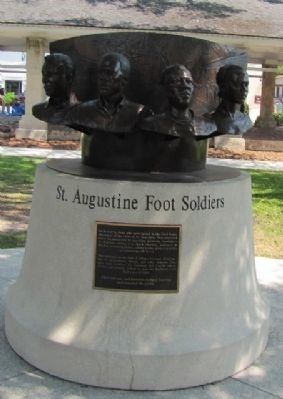
James R. Murray, May 22, 2014, photo
https://www.hmdb.org/m.asp?m=74381)
The St. Augustine Foot Soldiers Monument
Lincolnville Museum and Cultural Center
Lynching victim marker to be placed on St. Augustine visitor center grounds
Civil War Photography of St. Augustine
ACCORD Freedom Trail (details about events, sites, individuals)
5. American Beach:
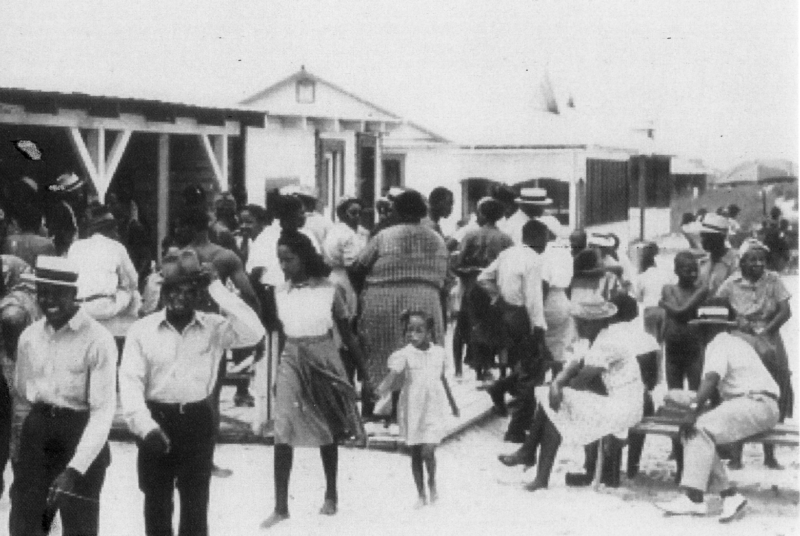
A. L. Lewis Museum | Origins & History
American Beach, Jacksonville, Florida (1936- ) •
American Beach: Only Beach in Florida to Welcome Blacks During Jim Crow | Black Then
A. L. Lewis Museum | Origins & History
6. Manhattan Beach and nearby:
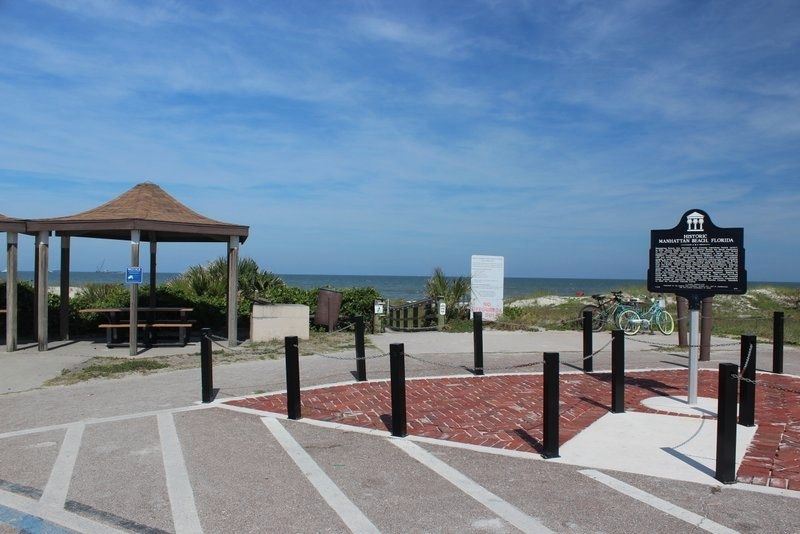
Tim Fillmon, May 25, 2021, photo
https://www.hmdb.org/m.asp?m=173936)
Recovering and Reclaiming Manhattan Beach (contact Jon Wolf, info@beachesmuseum.org, for access to educators’ and students’ activities covering Manhattan Beach)
Manhattan Beach Historic Marker Unveiling
Six Historically Black Beaches to Visit This Summer | by Angela Dennis | Medium
By Johnny Woodhouse
Pfc. DeWayne Corbitt grew up in a military family.
His mother and father served in the U.S. Army during World War II, and all three of his older brothers enlisted in the Army during the Vietnam War era.
But Corbitt, a 1967 graduate of Fletcher High School, bucked family tradition when he joined the U.S. Marine Corps in February 1968.
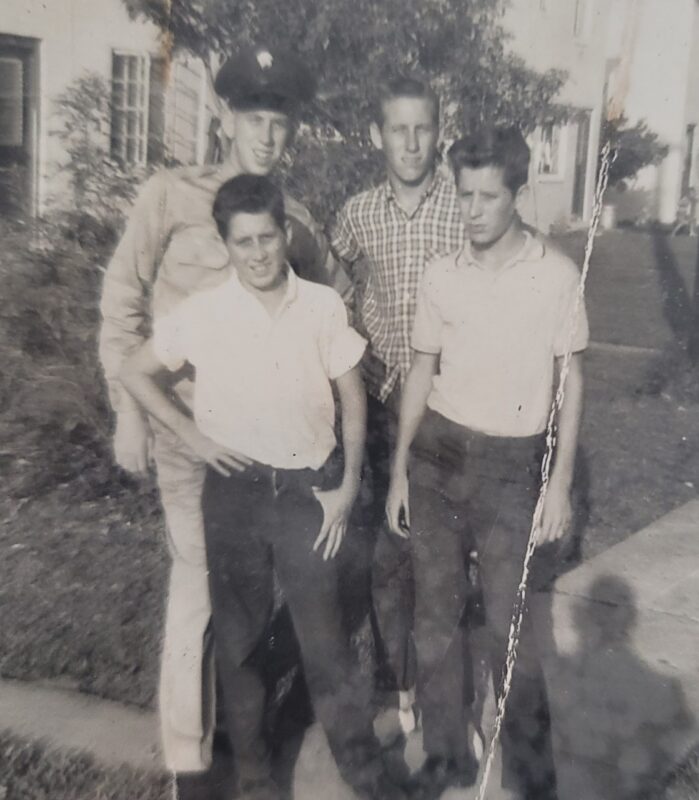
“He loved war movies, westerns and John Wayne,” said Corbitt’s older brother, Dennis, a retired high school teacher who served as an Army medic at Fort Benning, Ga., from 1962-65.
The second youngest of five children, DeWayne Corbitt was 14 when his father, World War II veteran Herbert E. Corbitt, died of cancer at the age of 40.
His mother, Maxine, who served in the Women’s Army Corps, worked as a dietician at Beaches Hospital when the family resided in the 900 block of 13th St. N., in Jacksonville Beach.
Four of the five Corbitt children attended Fletcher High, including Donald Herbert Corbitt, the second oldest, who was stationed in Germany and Korea during his Army service.
Dale Corbitt, a 1966 Fletcher grad, served in Vietnam as a machine gunner with an Armored Cavalry unit.
Frances Corbitt, a 1968 Fletcher grad, played four sports for the Lady Senators and sang in the school chorus.
“Part of her workouts included running knee-deep in the ocean,” said her daughter, Kelly McFarland of Tallahassee.
“All of them loved their time at Fletcher.”
Brothers in Arms
DeWayne Corbitt attended boot camp at Parris Island, S.C., and advanced infantry training at Camp Lejeune, N.C.
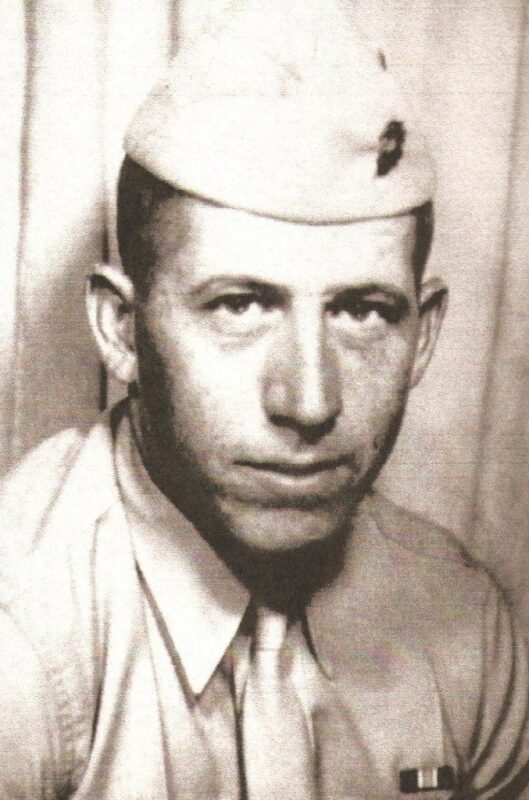
In June 1968, before his tour of duty in Vietnam began on Aug. 14, 1968, Corbitt spent a 20-day leave of absence in Jacksonville Beach.
Once overseas, he was assigned to the Marine Corps’ most decorated regiment, the 5th Marines.
During the Tet Offensive, 1st battalion, 5th Marines, engaged in fierce urban combat in the famous Citadel section of the ancient imperial city of Hue.
Corbitt wasn’t the only Jacksonville Beach resident serving overseas that summer. Pfc. William Raymond Gast, who also attended Fletcher, was assigned to Bravo Company, 1st Battalion, 5th Marines.
Both Corbitt and Gast were involved in Mameluke Thrust, a 1st Marine Division operation that ran from June-October 1968.
Gast, who joined the Marines in October 1967, and arrived in Vietnam in April 1968, was a prolific letter-writer during his tour of duty.
“It looks like we will be out in the bush from the 25th of August to the 15th of September,” one of his last letters said.
“It will probably be longer. No rest for the Marines.”
In other letters, Gast described his hatred of C-rations and canteen water treated with halazone disinfection tablets. He wrote that he once went 36 days without taking a shower and suffered from trench foot.
“My feet look like death warmed over,” he wrote. “It seems the other branches have it better than the Marines.”
Gast never made it back from his last mission, which was hampered by a Sept. 5 typhoon that swamped much of Quang Nam province where the 1st Battalion, 5th Marines were based.
He was missing in action for three days before his body was recovered. Gast was officially listed as killed in action on Sept. 10, 1968. He was 19.
Brief time in-country
In late August 1968, a platoon in Delta Company, 1st Battalion, 5th Marines, was ambushed near the Song Tinh Yen River. A dozen Marines were killed and another 18 were wounded.
According to his service record, Corbitt was assigned to Delta company, but it’s unknown if the platoon in question was his own.
“I know my Uncle Dale was in ‘Nam from 1968-1969, but my Uncle DeWayne was not there very long,” McFarland said.
“I’m not sure if he had time to write home from the day he landed until the day he was shot by a sniper on patrol.”
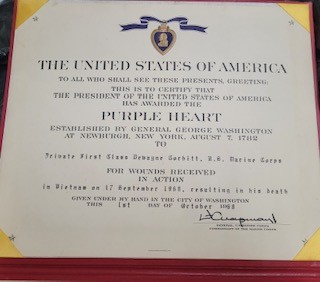
Pfc. DeWayne Corbitt was eight days shy of his 20th birthday when he was killed in action on Sept. 17, 1968.
According to a letter dated Sept. 27, 1968, and addressed to Dennis Corbitt, Lt. Col. Richard F. Daley, the commanding officer of 1st Battalion, 5th Marines, said Pfc. DeWayne Corbitt was mortally wounded by enemy small arms fire.
“A medical corpsman rushed to his aid immediately, but his wounds proved too severe, and DeWayne succumbed almost instantly,” the letter read.
“DeWayne was a sincere, hard-working young man who impressed everyone with his eager manner and courteous demeanor. He took great pride in doing every job well and constantly displayed those
qualities of eagerness and self-reliance that gained him the respect of his seniors and contemporaries alike.”
The letter went on to say that a memorial service held in Corbitt’s honor at the battalion chapel was attended by his many friends in the battalion.
The same day that Corbitt died, Sgt. Ray Hayes of Alpha Company, 1st Battalion, 5th Marines, was killed while leading a squad of Marines on a reconnaissance of the same hostile area.
According to Hayes’ silver star citation, “After penetrating the enemy line and disregarding his own safety, he fearlessly moved about a hazardous area until he had pinpointed the enemy emplacements and located an injured comrade.”
After reporting his tactical observations back to his commanding officer, Hayes, a platoon leader on his second tour of duty in Vietnam, was mortally wounded by enemy machine gun fire “while crossing the dangerous terrain.”
Like Corbitt, Hayes had only been in-country a few weeks before his death.
Buried with Honors
A memorial service for Corbitt was held on Sept. 29, 1968, in the chapel of Giddens-Griffin Funeral Home in Jacksonville Beach. The following day, Giddens-Griffin held a similar service for Gast, whose parents resided across the street from the original Fletcher campus in the 2000 block of 3rd Street North.
Gast is buried at Warren Smith Cemetery in Jacksonville Beach.
Corbitt’s remains were buried alongside his father’s grave at Hancock Cemetery in Fort Meade, Fla.
Dale Corbitt, who was serving in Vietnam at the time of his younger brother’s death and was exposed to the defoliant Agent Orange while overseas, was flown home to attend the funeral service.
He died in 2007 and is buried in the Florida National Cemetery in Bushnell, Fla. Donald Corbitt died in 2019 and is buried in the Jacksonville National Cemetery.
When McFarland and Dennis Corbitt learned that the Fallen Wartime Veterans Street Sign Program has plans to honor the memory of Pfc. DeWayne Corbitt with a special street sign in Jacksonville Beach, they were incredibly pleased.
“I wish my granny (Maxine Corbitt), my mom (Frances Corbitt Burke) and two of my uncles were still alive to see it,” McFarland said. “I feel like this is honoring them as well.”