
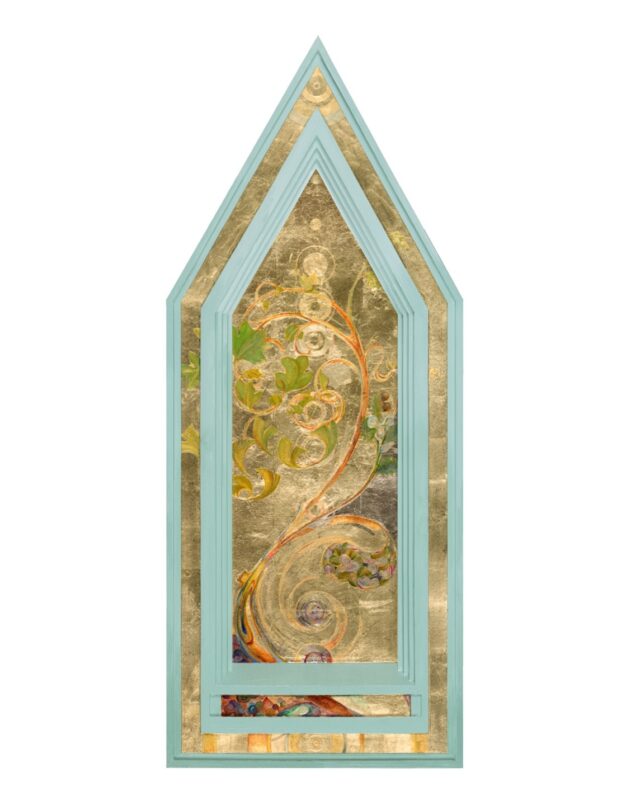
What presents itself as unity – frame and painting – had two separate developments which nevertheless influenced each other.
The story of the frame:
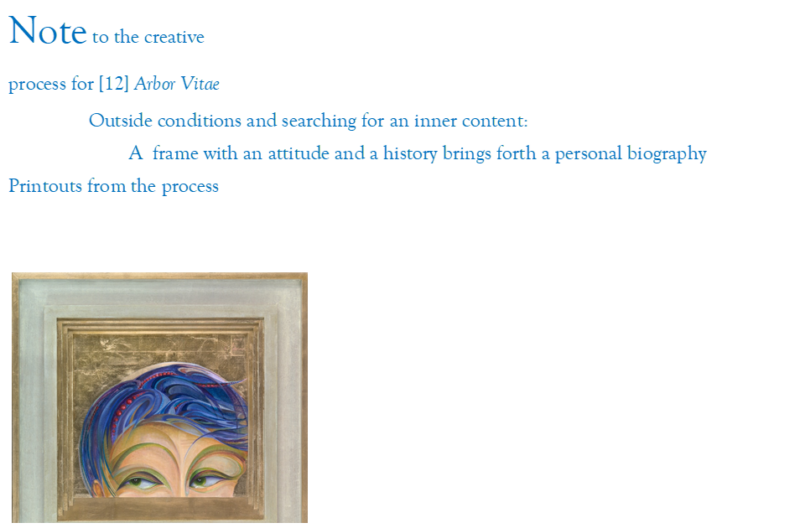
In 2005, I returned to the face for which I have a specific fondness as I painted it in the watercolor The End of a Long Day and the oil painting The Sea of Time; The new version was a small-sized canvas (11”x12”), titled Green Eyes, and the emphasis was laid on the pleading and searching turn of the eyes. To legitimize the missing “lower half of the face,” I wanted to have the face appearing in a window aperture. Either “inside” or “outside,” I am leaving it to the viewer’s discretion to decide the ambivalence if the face is looking from outside into an enclosed space (wanting to be part of that) or if the face belongs to someone inside a building, possibly trapped and longing for the freedom of the outside? I needed a “window-frame,” so I went to my framer, who had a longstanding work relationship with my art, possessed a wide background in creativity, and a passion for woodworking. A “window”: we spoke about profile and sill, stepped levels, and a slanted ledge. The frame turned out just ideal; I painted it slightly green, and extended the golden background on the stepped inner profile.
Because my framer also had a soft spot in his design heart for the medieval age, he experimented for himself with re-creating a Gothic-style, pointed arch window frame. The outcome was a straight-lined, multiple step-profiled frame in elongated, vertical proportions.
The pointed arch was solved by a triangular course, and the windowsill extended into a rectangular, subdivided foundation. That frame hung in his workshop high up on the wall, and I saw it often over the years. When illness carried him prematurely off from life, his widow told me her husband wanted me to inherit the frame, which is therefore also a personal memory and link to the best framer I could ever have. 2018, a dozen years after Green Eyes.
The story of the painting:
The frame undeniably has a “gothic” flair – and by its proportion, and by proportion and association, the only credible subject seemed to be a figure of a saint; and that topic I could not approach with integrity.
I left the “content” dilemma and focused again on the shape, the style, the proportions under strict compositional criteria. Not exactly “mathematics,” just thinking in lines, their direction, their weight, and extent. That sounds frighteningly theoretical – but I did it in praxis on paper with big brushstrokes. After some experimentation, the satisfying outcome was:
Diagonal, upwards, curvature, asymmetrical, counter-movement, and branching subdivision: definitely a plant, a tree. Painting a tree in a frame that has internalized “praise” in its shape?
But the composition looked really good in this counterplay of straights and curvatures, of vertical confinement and spreading out, and of the absence of a still-standing human figure, replaced by a vigorously expending tree.
I went for the tree and fought the narrowness of the central area by extending its width visually. It is an optical illusion: by continuing the golden background into the flat surfaces of the step-profile areas, the eye believes in a wider golden background, with a floating frame in front of it. Continuing the painting’s designs beyond the central area into the “margins” strengthens the illusion – and gives me more space for the extended composition.
Up to this point, it was still a very dynamically growing tree, with vigor and temperament, barely tamed by the side restrictions.
I started to paint and the simplicity of “a tree” no matter how lively switched suddenly into “the Tree of Life.” I ignored the tradition to see in this a listing of ancestral generations and interpret the figure as a symbol of a single life, growing from a seed from nourished ground (that are the generation before), passing through stages of growing (up wards) and adapting (course-directions), branching out (into different achievements), bearing blossoms and fruits (accomplishments) and continue to grow, until one day to ends in the ultimate point of the triangular closing of the available space.
The parallel to a human biography was unnegotiable and became my own. But how to bring an understanding of “development” into this wildly reaching-out dynamic? How to tell about the time and the areas of life?
To the swaying course of the trunk and branches, a visual axis was introduced, made from the most unexpected element of concentric circles, arranged along a central vertical axis. The circles grow out of the dynamic spirals; they are very thin, engraved, and barely colored lines, but they lead the eye from the bottom circle high up to the ultimate one in the triangle corner.
If one is willing to accept the circle as units of a decade, the bottom ones pass through childhood and schooling, the following through higher learning and unfolding possibilities, i.e. university, painting and research. The right side features some silver background with blossoms and acorn fruits – an allusion to school and research achievements resulting in to publication.
The tree features blossoms and fruits and three different kinds of leaves from gingko, tulip tree, and oak simultaneously. Plants, that are emotionally significant for me.