
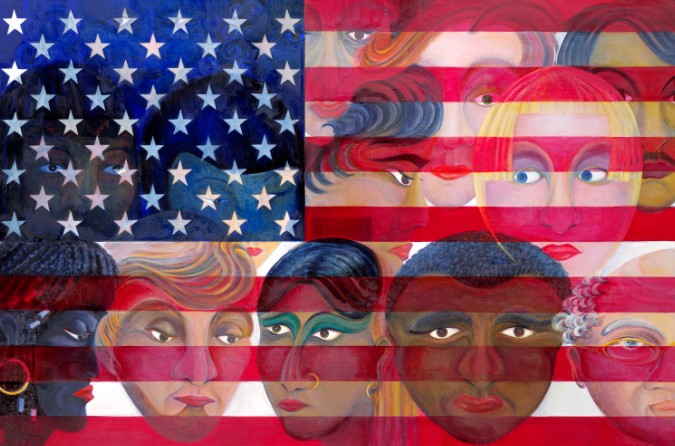
Note to the creative process for [9] America
Uniting a group of individuals under one shared emotional involvement
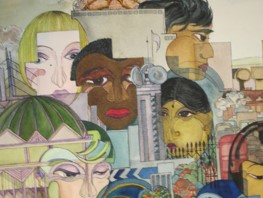
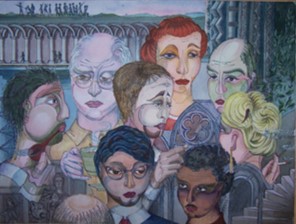
Forerunners: [9-1] People in London (watercolor), [9-2] Conference at Lincoln (watercolor),
 |  |
The shock of September 11, 2001, went through all the world, and the painting America is one of thousands upon thousands of reactions to this most horrendous day for New York, for the USA, and for the World.
The flag is the ultimate abstract symbol for the country, the freedom it fought for, the constitution, and the people themselves. In the painting, the stars and stripes of the flag bind together visually the population, in all its varieties and individualism.
Twice, before I set myself to this task of the “portrait” of America in this dark time, I had composed a “group portrait” where a number of people were assembled, sharing a common element. This in itself is a topic with a certain tradition in portrait art, mostly in a positive context.
The first one was London (or more detailed People in London) – the result of my observation of countless anonymous people that crossed my path when I lived for a year in London attending College. The isolation and loneliness I felt in public life and traffic transferred into the painting. Despite being incredibly squeezed in buses and the metro during rush hours, the person next to me, physically a breath apart, was psychologically in light-year distance.
This mood of isolation and solitude from the London year matched my search to express the loneliness experienced in grief and terror over the events, despite the fact that millions shared the same emotions.
And such, I did not create new portraits, but took the faces from the watercolor London in their wide variety; already “samples” of age, gender, ethnicity, race, culture, and social differences among the population – valid for London same as London as New York or America-at-large.
The second group portrait, Conference in Lincoln, presents an animated discussion group which the observer might mentally join. The topic of lively involvement – and the scene of the assembly – was the medieval Cathedral of Lincoln (Lincolnshire, United Kingdom) where a conference on its architecture took place (and I had the privilege to take part in this). The participants came from England, the European continent, and America. Scholars who specialized in medieval architecture, epoch, and culture discussed, explored, lectured, and climbed high up on the roof and walked the arched galleries. Short “visual” quotes from the building intermingle with the debate and permeate the minds. This “binding” together multiple individual parts (the portraits) under a shared interest worked out well in the watercolor. From this I took the idea to let the stars-and-stripes be the uniting force in a painting to strengthen a nation frozen in shock.
Thirteen stripes and thirteen faces: It takes scrutiny to discover behind the stars the portraits of a young Asian face, a Native American, and a white-haired elderly woman – representations of specific groups and minorities in the population, often overlooked. The portraits in clear view cover young and old, male and female, ethnic subgroups, and a mental set with an inward or outward preference.