
Exhibition No. 1 – oil on canvas. 1996. 16″ x 40″ / $15,000
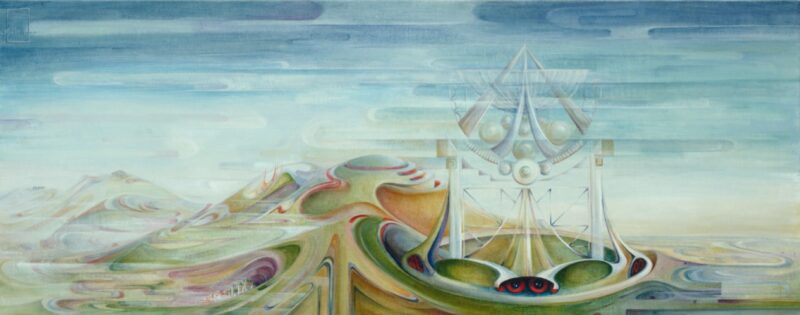
Placed in a symbolic landscape spanning centuries, architectural remains recall former civilizations and their spiritual gathering centers. In the misty distance of millennia, the ruins of Stonehenge are barely visible.
A Greek temple from a classical age tops the mountain, while Medieval Times disappear in a dark transitional tunnel. On the other side of that mountain, the Renaissance of the analytical spirit appears, which pinnacles in the 20th Century. The radio telescope represents our present philosophy that science and technology will answer every question, including our search for the origin and destiny of humankind.
For this answer, we are still waiting.
| Note to the creative process for [1] Still Waiting A heroic scientific device of the human longing to know its cosmic origin. |
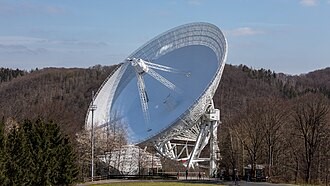
Photograph of the Radio Telescope Max-Planck Effelsberg, Germany, constructed 1972. Max-Planck Institute for Radio Astronomy. (Source: Wikimedia Commons)
The observer might wonder why a radio telescope is the “hero” in a painting. There is always a reason, recognized or unknown, why something is of impressive importance.
The artist’s fascination with astronomy might give the emotional foundation; the painter’s experience visiting in person the location of this monumental scientific “device” explains the impact of a dish with a 100-meter (yard) diameter and the intellectual admiration for (at it 1972 its time of inauguration) the world’s largest fully movable telescope.
The telescope is treated like a sculpture, a piece of scientific and engineering art of the later 20th century. It was developed and constructed to scan the deep space for radio signals – of stars and also of intelligent sources.
Therefore, the title emerged during the oil painting process: “Still Waiting,” which would, in full, mean “still waiting for an answer” in the search for signals from “other” intelligences in the cosmos.
The artistic development of the small canvas is without a preceding composition. Something made me place the telescope, the object in the center of attention, in an asymmetrical position in the horizontally orientated canvas, i.e., into the right half, moved away from a central placement. Right, because it is our western habit of reading and seeing, so unquestionable and self-evident for our culture, that we never consider this strong habit underlying many decisions concerning directions.
While painting and contemplating the potential to find and prove traces of intelligence in the cosmos, I found that the landscape not only had geological expansion but could also be read symbolically as a “travel” of time. In the contemporary scientific search, I saw a legitimate comparison with humankind’s insatiable desire to discover and learn about its origins on Earth, as for millennia this question has lived through myths and religious concepts. Consequently, I added miniaturized images of outstanding architecture, representing three out of many eras and epochs of known civilization: Stonehenge, a classic Greek temple, and a medieval abbey complex. Each of these edifices housed rituals and heard prayers addressing a sacred entity in the skies and pleas to answer the questions of our origin. In the late 20th century, with the radio telescope, we are “Still Waiting” for a response.
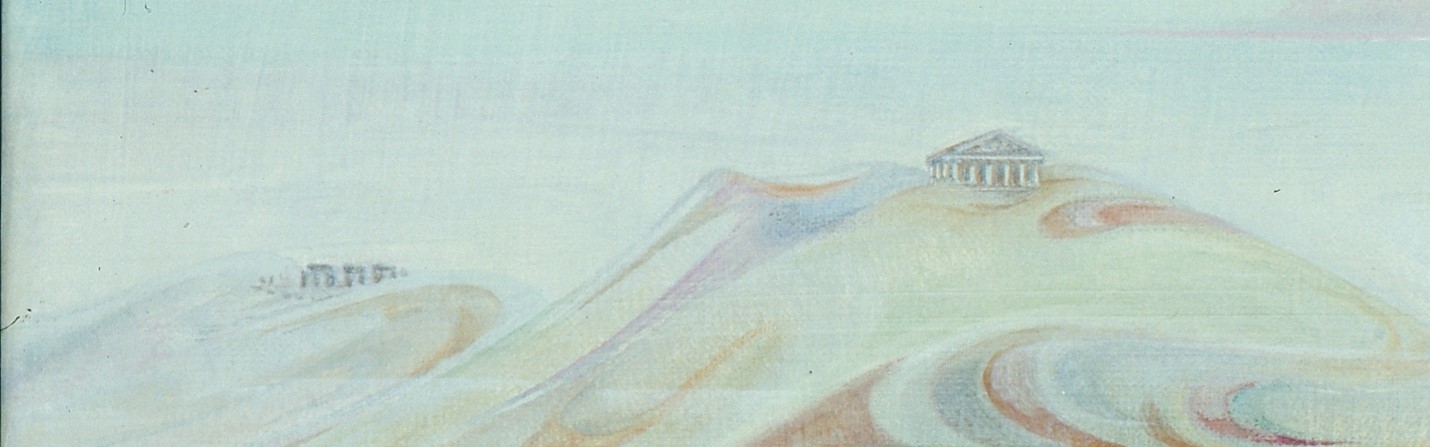 Detail for Stonehenge and Greek Temple | 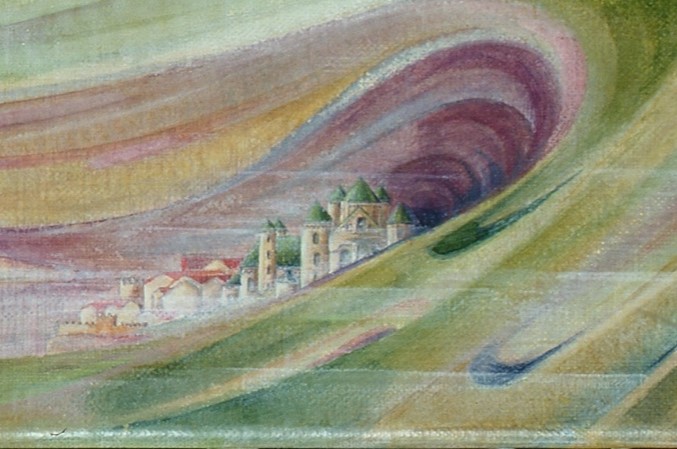 Detail for Medieval Abbey |