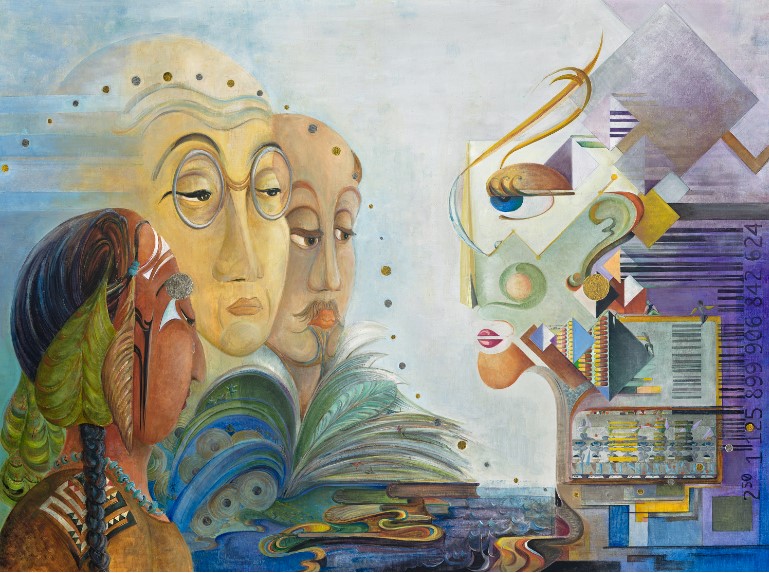
Exhibition No. 7 – oil and gold leaf on canvas. 2017. 30″ x 40″ / $30,000
Every epoch looks back to its predecessors, disapproving of their so-called primitiveness, and is proud to have developed to a higher plateau. The duration of such epochs seems to get shorter and shorter; for example, the Medieval Ages stretched over several centuries, whereas the Industrial Revolution came and went in two hundred years. The Atomic Age lasted barely 30 years before it was trumped by the electronic age. Since the new millennium, man has seen a racing growth in computer capacities and artificial intelligence that have leaped in their byte counts from Mega to Giga and reached already Tetra. Now, as the next mark, appears the Petabyte, which stores information in a size of 250, 1.000 Gigabytes (250 = 1,125,899,906,842,624: more than one quadrillion).
The electronically steered regulation, be it of body and mind, motion and connectivity with the environment, or from the private room to the last corner of the planet, seems light-years ahead of the life we thought we knew 50 years ago. Between the way of living, thinking, and planning of the late 20th Century and the modern world of the 21st Century grows an abyss, and the chances of being bridged diminish. Our progress in scientific understanding of the human being is overshadowed by the rapid disappearance of humanistic and social achievements that took centuries to develop and are now doomed to sink into oblivion.
This confrontation is portrayed in this image, where the representations of the highly evolved civilizations of the West and the East, and also the traditional cultures of native populations (still in unity with their natural environment), clash with the rising giant of a new type of humans and societies. We might celebrate the ongoing receding necessity to rely on our brain’s memory; downloading information into the brain is not far in the future. But should we thoughtlessly shun the mental capacity which was used to memorize volumes of written material? Once the dependency on the digital source for knowledge is established, the mechanisms of selection and exclusion (and the control of them) will be irreversible.
It might seem to many people that the new achievements of speed, comfort, and total integration of man and machine are pure bliss. They might consider it a minor sacrifice when humankind is losing the sensitivity for natural life (like that of the native track reader), the ethical code (of Confucian life for the network of family, town, tribe, and nation), or the understanding of human dimensions (as they have been portrayed in Shakespeare’s dramas. But if those mentioned examples were compared – as an analogy –with losing individual letters of the alphabet, then language-bound knowledge would disappear in rapid time.
It is questionable if the human psyche, already in turmoil over the inhuman pace of changes and interventions for the last 300 years, can uphold the fundamental, positive humane behavior in a vortex of isolation, digitalization, and automatization.
The clash is palpable. The melancholic and pleading looks on the losers’ side meet with a cold, emotionless stare, a total lack of understanding.
| Note to the creative process for [7] Petabyte Abyss Drawing from different sources, combining in complex unity of a topic [7-1] Bust portrait, furthermore: Shakespeare (watercolor), see image below The Era of Books (watercolor), see image below Four World Concepts (print of an oil painting, 1992) see image below |
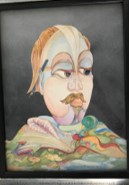 | 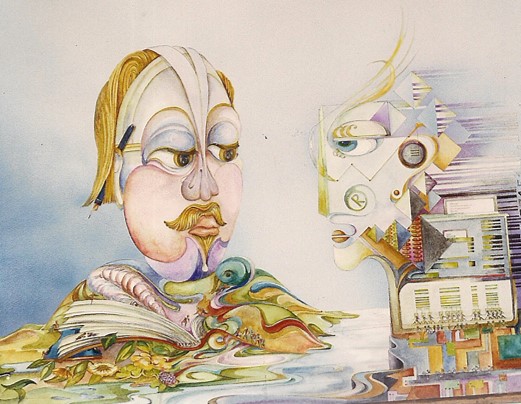 | 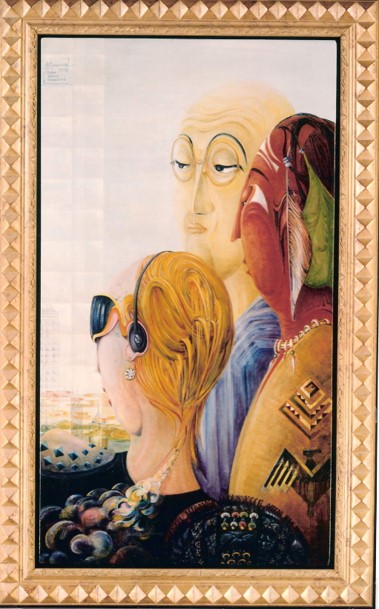 | 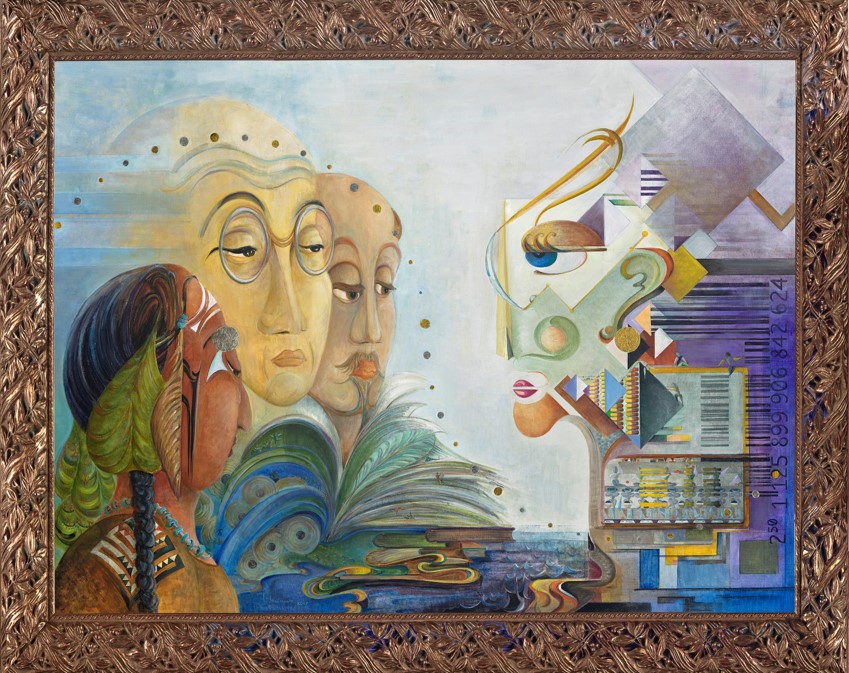 |
Shakespeare is a fantasy portrait that reminded me of the famous portrait of the English poet as it appeared on the introduction page of the first folio edition of his works, and the bust below the face is filled with associations of the rich creativity in his sonnets and dramas. He represents a history of civilization grown on books for millennia and in the last quarter of the 20th century, a serious challenge arose with the advent of computers that exploded in magnitudes. This “facial duel” played out in The Era of Books, and sadly, instead of co-existence, the gap widened. Four World Concepts expresses the disagreement among the people and cultures how to deal and react to the fast and faster developments.
When I picked up in 2017 the concept of The Era of Books I wanted to include whole humanity, not only the traditional European one and extended the design with the Asian civilizations and the culture and wisdom of indigenous cultures, many of them threatened to disappear without lasting records.
Comparing details of The Era of Books and Petabyte Abyss explains better than words how the idea got further developed.
Even the rather traditional frame around the contemporary conflict is pulled into the scene by the coloration of the canvas “bleeding in” and undermines the integrity of the carving.