
Exhibition No. 8 – oil and silver leaf on board. 1982-84. 29″ x 40″
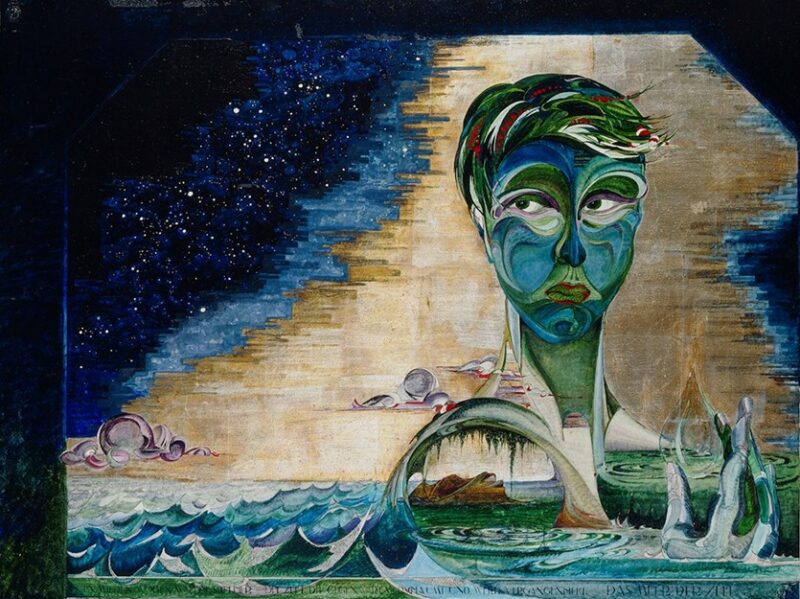
“TIME ROLLS AROUND IN WILD WAVES –
THE PRESENT FOAMS AND BECOMES PAST”
These words form a subtitle to the painting written at its bottom; the two lines (written in German translation) are quoted from an ancient Chinese poem to explain the artist’s title Sea of Time.
The inspiration came when crossing the English Channel in a Hovercraft and watching the chopping sea through the window at arm’s length. The mind wandered and got lost in the fantasy, seeing in every upheaval of waves a decade or a century in human history. Time became an analogy for the rhythm of development and decay in every civilization, culture, nation over the millennia of our known history.
But for every human, his/her own life is in the center of their thoughts. Their personal “drop of life” is unique for everybody. The imaginary spirit of the time is holding up this special drop.
The windswept hair is permeated with red beads of mental energy; and the eyes turn back in a compelling look.
| Note to the creative process for [8] The Sea of Time And a face with individual grievance in a small lifet turns into eternal neutrality Forerunner: [8-1] The End of A Long Day (watercolor) |
There was a beautiful poem, composed over 1.500 years ago, and half the world away. The Chinese poet Tao Yuanming (365-427 CE) wrote a philosophical contemplation, which I read in the 20th century in its German translation, and it impressed me immensely, above all in his symbolic correlation to the strangest of all forces, Time. He wrote,
“Time rolls in on wild, surging waves;
the present foams away and turns to the past.” (These lines are quoted in German at the bottom of the image)
Once this symbolic image is visualized, the scene of the moving surface of the ocean becomes an overwhelming symbol of Time – moment after moment – we cannot hold a single handful of water, not a single minute of a day; everything is in unstoppable, permanent movement. Instead of mourning the impossibility of freezing the flow, it is more successful to understand ourselves as moving, passing, morphing, changing beings with no thought equal to another.
One drop only, over-proportionally huge, is held up by an imaginary entity – one drop out of an ocean, one moment from the sea of time, one lifetime among trillions: but our life is still the most important one and monumental in its significance for us.
[8-1] The End of A Long Day
The watercolor centers on a bust portrait, in the act of reviewing and taking stock of millennia of evolution and human history. The rising signs at the horizon spell “Global 2000,” leading to a critical and pessimistic outlook. On the shoulder of the bust, a 12-part subdivision in the nature of a clock dial indicates that time is running out. In planetary and stellar dimensions, the evolution on Earth might be short like a day, but for us humans, it is infinitely long. The awareness of time in relation to human life is fluctuating between praise of technical progress and despair at how little we really matured.
The watercolor’s face with its distinctive features finds its continuation in the oil painting The Sea of Time, in which the theme of our Existential Question, the trifle of our threescore years and ten embedded in billions of years in galactic lives, gives us the credit of a drop in the ocean.