
Exhibition No. 2 – oil and silver leaf on canvas. 1998. 32″ x 32″ / $18,000
Inspired by medieval tracery, a richly profiled frame sets off an island of spiritual contemplation in the buzzing secularity of daily life’s activities. The Latin title enforces the allegoric meaning in the image of a dynamically growing tree on a golden background.
From roots deeply anchored in the rocks of millennia of ancestors, the young sprig bursts with a dashing curve into life. Social conditions set the formative years when some potentials get clipped, and education tames the exuberant energy to rebel and explore. While the spiral unfolds, the learning bears blossoms, direction forks, and the genuine core enfolds.
The single trunk branches into clusters with Gingko, Tulip tree, and Oak leaves – demonstrating that a range of specialization can dwell in harmony. One side of the tree carries the weight of academic learning while the other half thrives effortlessly in creativity.
Like a spiritual axis, a column of energetic vortexes in the golden background moves discreetly upward and beyond the top – they might encapsulate the rises through the decades of past and future.
| Note to the creative process for [2] Epochs of Mankind A life-class study turns into a philosophical-existential contemplation [2-1] Epochs of Mankind (watercolor) [2-2] Sitting Female Nude (print out from Life-Class study) 1980 |
Epochs of Mankind
In the introduction to this exhibition, I show with the two watercolors of a landscape (Cornwall 1 and Cornwall 2) an example of “translation” in art regarding style, i.e. from naturalistic appearance into (in my case) a stylized form to express my intention and interpretation of forms and contents.
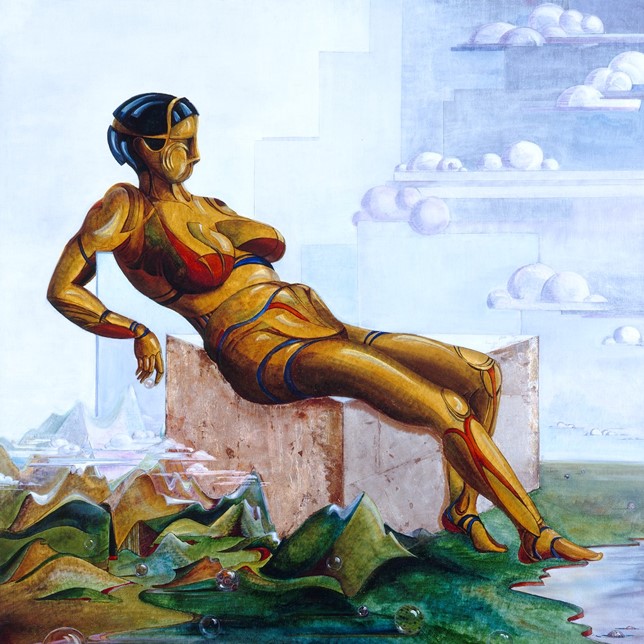
As I did with the landscape, so I did with the naturalistic drawings as I drew for study in life-class sittings. In this exhibition I show two of those “translated” figures in [2] Epochs of Mankind and in [3] Sleeper. With the change into stylization came also a specific meaning, a philosophical contemplation which found its expression (by my interpretation) first of all in the posture of the model. The nude human being in the drawing, besides gender and age, had nothing else than the posture to convey a mood of mind or intention of action; no indication of historical, ethnical, cultural, or socially relevant information – only the posture. With the stylization, this posture is even more emphasized, and my association found intuitive expression with scarcely elaborated details and a title that jumped into the head: Epochs of Mankind, which catapulted the sitting model out of reality, and she became a figurative representative of the abstract force of Time, like the gods of Antiquity.
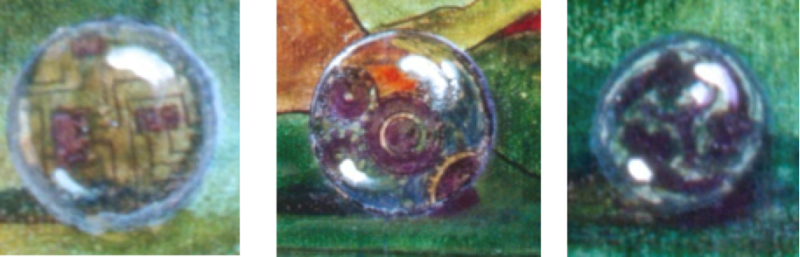
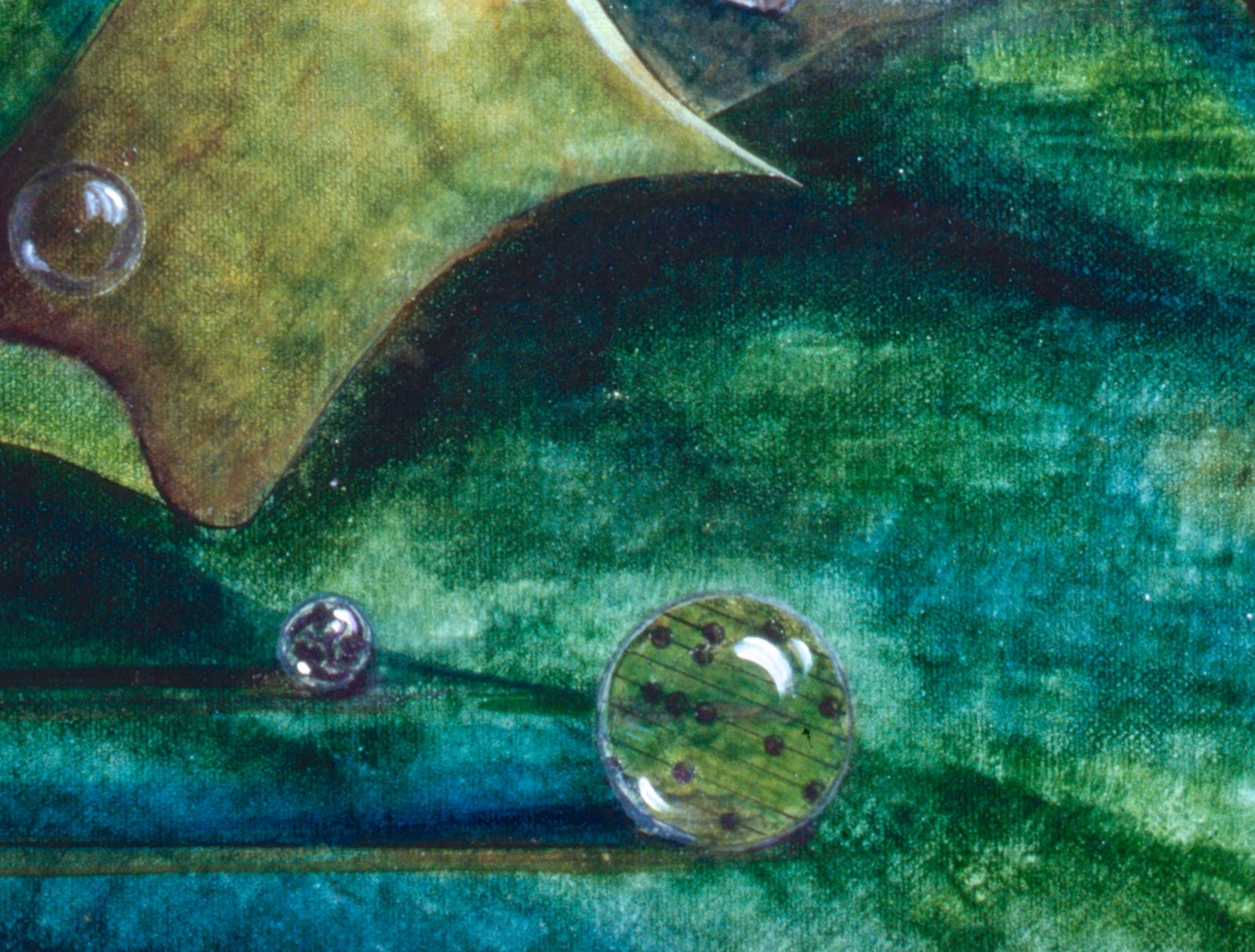
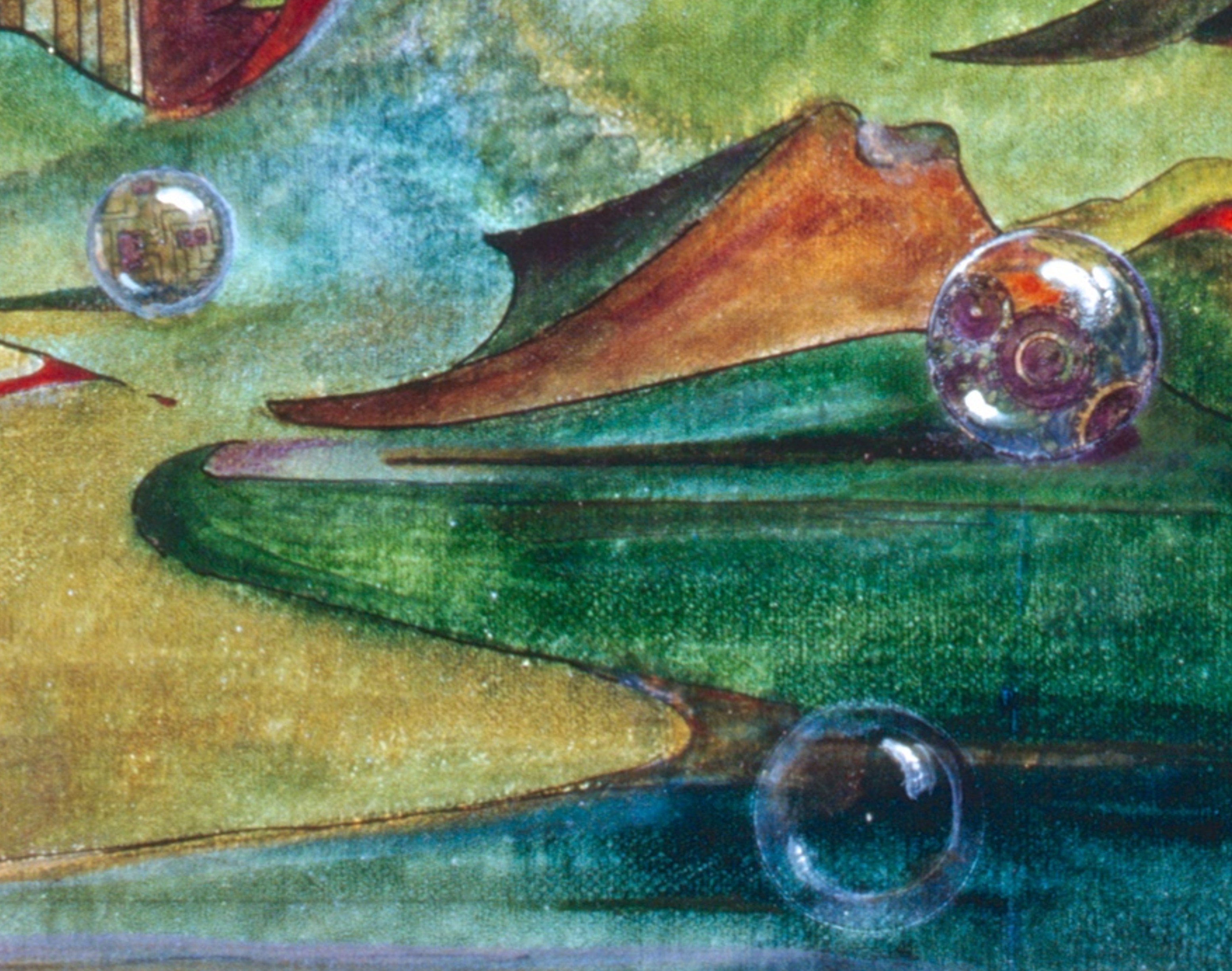
In the drawing class, the model rested her armpit on the back of the chair, which is hinted at in the watercolor by an abstract block; but in the oil painting, the surreality is unescapable: the sitter leans on air – and the dwarfed mountain scape to her feet monumentalizes the entity, larger to be larger than the a “Goddess of Time”, who totally relaxed, non-caring, drops century after century on the planet. The close-up look at the bubbles – for her a moment, for humans hundreds of years – reveals certain epochs in human history: cuneiform script, a gothic window, an abacus, a spoke wheel. An electronic circuit occupies the bubble just ready to be dropped: in 1988, the computer age was still at dawn.
 |  |