
Mayport Native Served in Dangerous Waters During World War II
By Johnny Woodhouse
In late January 1942, Mayport native Charles Lewis Ruffin, 22, was employed as a pantry helper on the Seminole, a steam-powered passenger ship that provided luxury travel between New York City and the South.
A floating palace, the Seminole, along with its sister ships, the Algonquin, Cherokee and Mohawk, were billed as the most luxurious on the Atlantic Coast and the pride and joy of the Clyde-Mallory Line.
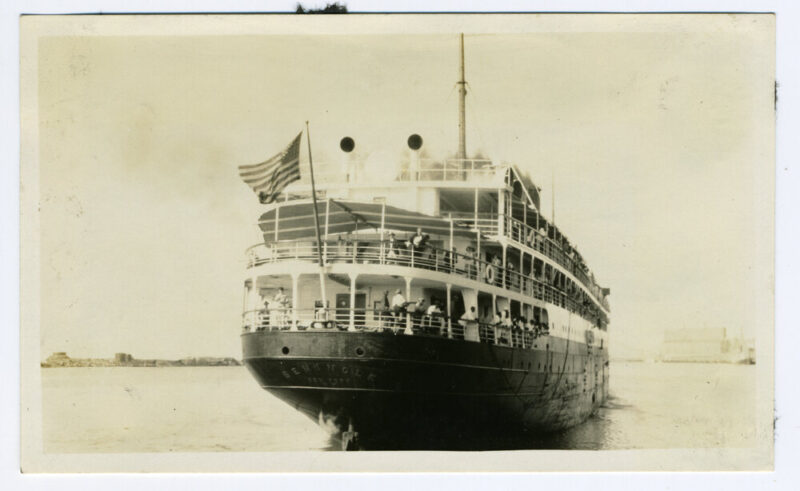
“They are, I believe, the finest coastwise service vessels in the world,” said Clyde Line president H.H. Raymond in February 1926.
By 1943, both the Seminole and Cherokee, two of the eight merchant ships Ruffin sailed on between 1941 and 1942, would be victims of a vicious German U-boat campaign that resulted in the sinking of more than 2,700 merchant ships during World War II.
During 1942 alone, deadly Nazi submarines sank 1,322 merchant vessels, including the SS Mariana, a merchant steamer Ruffin boarded on March 3, 1942.
Family ties to Mayport fish house
Born Oct. 24, 1919, in Mayport, Ruffin grew up on Henry Street. His maternal grandfather, Isaac “Ike” Lewis, owned and operated a waterfront business known as the Old Reliable Fish Market.

When he was not attending classes at the School for Blacks in East Mayport, Ruffin’s uncle, Antonio “Tony” Lewis, babysat young Charlie and his brother, Wilbur, while their mother, Edna Lewis Ruffin, washed and ironed clothes to make ends meet as a single mother.
When fish were scarce, Tony Lewis and his brother, “Sonny Boy,” worked in their father’s woodyard or delivered ice out of the back of an old Model T Ford.
“That’s when most people, especially blacks, didn’t have ice boxes, and put ice in the ground in sawdust,” Tony Lewis recalled in 1981.
Yearning to change his station in life, Lewis eventually took to the sea, working on dredge boats up and down the St. Johns River.
Lewis eventually left the riverboat life to become a restaurant chef in Jacksonville, the cafeteria manager at Prudential Insurance Co. and finally the proprietor of Tony’s Seafood Shack on Mayport Road for more than 25 years. He died in 2007 at the age of 96.
Following his uncle’s lead
After toiling in his grandfather’s fish house, Charlie Ruffin also longed for a new adventure far from the docks of Mayport.
On Jan. 23, 1941, he applied for a seaman’s certificate to work as either an ordinary seaman or a wiper on a merchant ship.
Six days later, he got his wish, earning a berth as a deckhand aboard the SS Shawnee, another passenger steamer for the Clyde-Mallory Line but bigger and more luxurious than the Seminole or Cherokee.
Ruffin spent more than a month on the four-deck luxury liner, which was powered by four steam turbines and carried more than 700 passengers and a crew of 175.
When he returned home to Mayport, Ruffin updated his Merchant Marine job ratings to include an endorsement for steward, which would allow him to work in a ship’s galley, where food is prepared and cooked for the passengers and crew.
The very next day, he was working as a second messman on the steamship York, followed by a 70-day assignment in the officer’s mess of the Shawnee, which offered roundtrip passenger service between Jacksonville and New York City.
In late June 1941, Ruffin served as a cook on the USAT John L. Clem, a former passenger liner converted into a troop carrier. At the time, Ruffin had no idea that his six-week service aboard the Army vessel would qualify him for veteran’s benefits decades later.
Switching his rate sealed his fate
For the remainder of 1941, Ruffin served exclusively on Clyde-Mallory passenger liners, including as a messman and dishwasher on the Cherokee, a utilityman on the Algonquin and the Seminole and a messman on the Gulfbreeze.
During his time ashore between the Shawnee and the John L. Clem, Ruffin traveled to Savannah, Georgia, to become endorsed for a third rating, this time as a coal passer in the engine room.
Maintaining steam was a constant chore at sea, according to steelnavy.org. The physically demanding job took place in the hottest parts of the ship, far below the waterline, where ventilation was at a minimum.
A coal passer manually moved coal, mostly by shovel, from the ship’s main storage bunkers to the stokehold or fire room where men known as stokers fed it into boilers.
“The man who worked down in that inferno of constant heat and danger was truly the super unsung hero of World War II,” wrote Walker D. Diamond, a retired U.S. Navy warrant officer, in his 1964 book “Memoirs of Ships and Men.”
Why Ruffin made the switch from food service worker to engine room attendant will never be known.
But by doing so, he may have unknowingly signed his death warrant.
Crossing paths with the enemy
With its multi-purpose foremast near the bow, the SS Mariana hardly resembled the sleek luxury liners Ruffin was used to working on for the better part of 1941. An American freighter built in 1915 at Newport News, Virginia, the Mariana was strictly a cargo vessel.
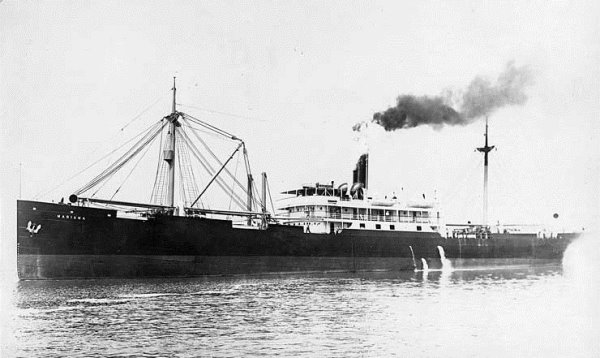
In 1918, the New York-based ship was requisitioned by the U.S. Navy for troop transport duty during World War I. The ship made two Atlantic crossings to France, carrying troops and supplies to the warfront before being returned to its owner, the New York & Puerto Rician Steamship Co., in April 1919.
Its sister ship, the SS Carolina, was not so lucky. It was sunk by a German U-boat on June 2, 1918, ending its 12-year lifespan.
In 1936, the SS Mariana changed owners but not her name.
On March 3, 1942, the freighter left Guánica, Puerto Rico, for Boston with 4,000 pounds of sugar, the island’s key export. Under the command of Capt. Ivan Elroy Hurlstone, a native of the Cayman Islands, the Mariana carried a crew of 34, including eight officers.
Ruffin was one of three coal passers in the ship’s engine room. Two days later, on March 5, 1942, the SS Marina was sailing north of the Turks and Caicos Islands when it unknowingly crossed paths with German U-boat 126, under the command of Capt. Ernst Bauer.
U-126 had already sunk or damaged 11 other ships, including the Norwegian merchant ship Gunny on March 2, 1942, when it fired on the unarmed SS Marina just after dusk on March 5, 1942.
According to Eric Wiberg, the author of over 40 books on maritime, aviation and World War II history, U-126 struck the SS Mariana with one torpedo, penetrating its hull. It only took five minutes for the merchant ship to sink, Wiberg said.
There were no survivors.
None of the freighter’s lifeboats or rafts were ever found.
When the ship was overdue in Boston, Wiberg said the Navy and commercial interests could only speculate as to its demise.
Merchant mariners get their due
Dorothy Ruffin Greene was only a year old when her older brother was killed. The 84-year-old Jacksonville resident said she grew up with little to no information about his fate.
“All we ever heard was that he was lost at sea,” said her son, Lucious Greene.
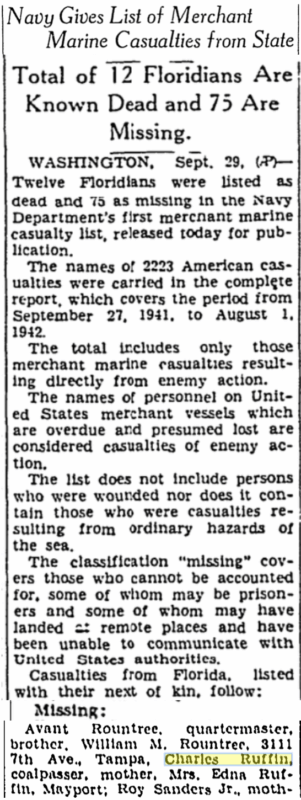
In late September 1942, seven months after the sinking of the SS Mariana, the first list of Merchant Marine casualties from the state of Florida was released by the Navy.
Charles Ruffin, coal passer, was listed as missing, a classification covering those who had not been accounted for at that time.
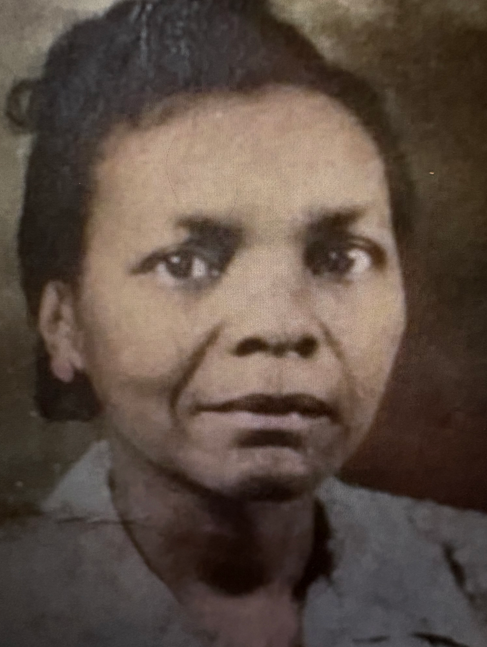

Pictured: Edna Ruffin, left, and Charles Ruffin, right
Between 1939 and 1945, 9,521 merchant mariners lost their lives — a higher proportion than those killed than in any military branch, according to the National World War II Museum.
In 1988, merchant mariners became eligible for benefits through the Department of Veterans Affairs.
In 2020, Congress passed the Merchant Mariners of World War II Congressional Gold Medal Act to recognize the merchant mariners for their courage and contributions during the war.
Ruffin, whose name was recently added to a new war memorial in Atlantic Beach, may be eligible for both the Congressional Gold Medal and the Mariner’s Medal, an award established by Congress in 1943 to honor civilian sailors who were killed, wounded or suffered from dangerous exposure due to enemy action.
A total of 6,635 Mariner’s Medals were awarded during World War II.
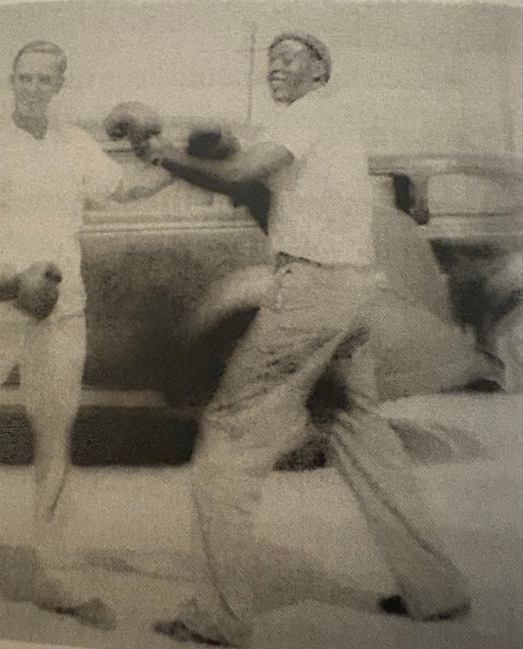
In her 1992 book, “Mayport Remembered: Along the Waterfront,” Helen Cooper Floyd included a photo of Ruffin and her husband, Hilton Floyd, playfully boxing “in the wide space between the [Lewis] fish house and Ocean Street.”
Ruffin and Hilton are smiling in the blurry, black-and-white image, which was taken in 1940, the year the Selective Service Act was passed by Congress, establishing the first peacetime draft and requiring all able-bodied men between the ages of 21 and 35 to register for potential military service.
Pictured: Charles Ruffin, right boxing with Hilton Floyd, left
Ruffin registered for the draft days before his 21st birthday.
“Both men left the Mayport waterfront scene at the onset of World War II,” Helen Cooper Floyd recounted in her 1992 book.
“Hilton, like many of his boyhood friends, returned at war’s end with scars and medals. Charlie did not come home.”
For more information about the Lewis-Ruffin family, visit the Rhoda Martin Center in Jacksonville Beach. A copy of “Memoirs of Ships and Men” by former Neptune Beach resident Walker DeWitt Diamond can be found in the Reading Room of the Beaches Museum.